Who this is for
Households that want one CO alarm per level, done once, with no battery ritual — and that want the earlier warning when the source is a generator running too close to the house.
Skip if
Skip it if someone at home has a heart or lung condition and needs warning below 30 ppm: Kidde's own sheet points that household at a different class of device, and this is not it. Skip it for an unheated garage or any space that drops under 40 °F. And it does not interconnect, so it cannot be the only alarm in a multi-level house.
Preparedness Gear
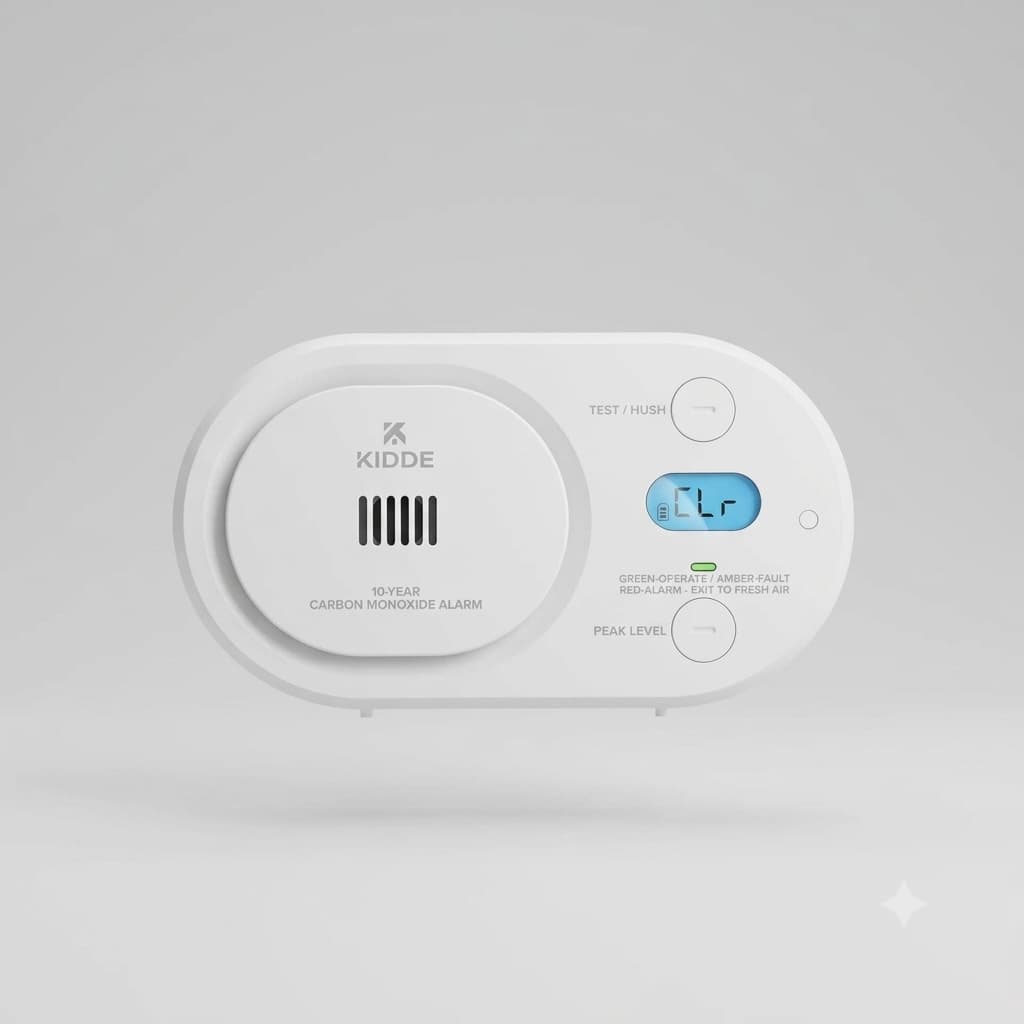
Kidde Carbon Monoxide Alarm, 10-Year Battery with Low-Level Alert (COBDL10)
Evaluated for household use · Affiliate links disclosed
The alarm we would put in a house that runs a generator: sealed ten-year battery, an earlier warning at dangerous levels, and an honest limit stated by the manufacturer.
Why we chose it
It answers the sentence three of our own guides already end on — a battery-powered CO alarm in the house — and it does it with a sealed ten-year cell and an earlier alert at the levels that matter. The manufacturer states its own limit in writing, which is the kind of honesty that makes a recommendation easy.
Buy From
Kidde (official site)Affiliate links · We earn a small commission at no cost to you. How this works
We evaluate every pick for real-world reliability.
Why this matters
Why this matters in an emergency
Carbon monoxide has no smell, no color, and no taste. That single fact is why it kills people that would have walked outside if they'd known — and why every piece of outage advice on this site that involves burning something ends with the same sentence about an alarm.
The scenario is ordinary, not dramatic. The power goes out. A generator goes on, a little too close to the house, or in a garage with the door open because it's raining. Or the furnace is off and someone gets creative about heat. Carbon monoxide doesn't announce any of it. The people most affected are often asleep, and the early symptoms — headache, tiredness, a bit of nausea — read exactly like a bad night in a cold house.
An alarm is the only thing in that chain that reliably interrupts it. It is also, unusually for preparedness gear, cheap, small, and finished — you buy it once, put it where it belongs, and it either sits quiet for a decade or it saves somebody. There isn't much else on this site with that shape.
How We Evaluated
How we evaluated this
We researched the COBDL10 the way we'd shop for our own house, and we'll say plainly we haven't run this unit ourselves.
The specs come from Kidde's model-specific product data sheet — the two-page PDF for the COBDL10, not the marketing page, because the product pages for this line render their details in a way that hands an automated reader the same generic text for every model. The alarm timings, the operating range, the 85-decibel rating, the warranty and the UL 2034 conformance are all read off that sheet. We pulled the COB10 sheet too, so the comparison below is between two documents rather than between a document and a memory.
For everything that isn't a spec — where alarms go, how often to test them, what to do when one sounds — we used NFPA rather than general web coverage. For what counts as a normal amount of carbon monoxide in a house, we used the EPA. One thing we deliberately left out: that EPA page also lists workplace exposure limits, and those are eight-hour averages written for healthy adults on a job. They are not household safety lines, and we won't present them as any.
Where we couldn't verify something, we say so rather than filling the gap. The biggest of those is owner history, and it has its own section below.
Our pick: Kidde Carbon Monoxide Alarm, 10-Year Battery with Low-Level Alert (COBDL10)
The verdict
A carbon monoxide alarm is the one piece of safety gear this site recommends without hedging, and the COBDL10 is the version we'd point most households at: a sealed 10-year battery, so there's nothing to replace and nothing to chirp at 3 a.m. because someone borrowed the nine-volt. It's a standalone alarm you set on a shelf or hang on a wall, and it runs on its own cell — which matters more than it sounds, because the moment our own guides tell you a CO alarm is non-negotiable is a power outage, and a plug-in alarm is a paperweight then. What separates it from Kidde's plainer COB10 is timing, not sensitivity. Both alarm at the same dangerous levels. The COBDL10 adds an earlier warning at those same levels — at 70 ppm it alerts in 21 minutes or less, where the standard alarm pattern can take anywhere from 60 to 240 minutes. When the source is a generator running too close to the house, that difference is the whole point. Two honest limits, both from Kidde's own data sheet. It does not warn below 30 ppm, and Kidde says plainly that people with certain medical conditions should consider a device that signals under that level — this is not that device. And it's rated to operate between 40 and 100 degrees Fahrenheit, which is worth knowing if you're planning around a house that loses heat. We researched this from Kidde's published data sheets plus NFPA and EPA guidance; we haven't run one ourselves.
- Sealed ten-year battery — nothing to replace, and nothing to borrow
- Alerts earlier than the standard pattern at the same concentrations
- Backlit display with a peak-level recall, readable in the dark
- Holds low-battery chirps at night instead of waking the house
- Tells you when it has reached end of life, with its own signal
- Does not warn below 30 ppm — Kidde points medically vulnerable households to a different class of device
- Rated only from 40 to 100 °F, so an unheated garage or a cold house can fall outside its range
- Standalone: it will not trigger other alarms, so you need one on each level
- We could not source owner failure history, so field reliability is unproven either way
The timing is the product. Every CO alarm sold in the US to UL 2034 waits before it sounds, on purpose. Kidde's sheet lists the alarm window plainly: at 70 ppm, somewhere between 60 and 240 minutes; at 150 ppm, 10 to 50 minutes; at 400 ppm, 4 to 15 minutes. That delay isn't a defect. It's what keeps an alarm from screaming every time a gas oven runs, and an alarm that cries wolf is an alarm somebody takes the battery out of.
The COBDL10 adds a second, earlier signal at those same concentrations — 70 ppm in 21 minutes or less, 150 ppm in 9 or less, 400 ppm in 4 or less. It sounds different on purpose: two short beeps rather than four, with the red light blinking twice every ten seconds. That's the feature worth paying for, and it's the entire difference from the COB10.
Be careful what "low-level" means here. It means sooner at the same levels, not sensitive to lower ones. Both of these alarms are quiet below 30 ppm, and Kidde's own data sheet is direct about the consequence: the alarm "will not fully safeguard individuals with specific medical conditions," and people with those conditions "may consider using warning devices which provide audible and visual signals for carbon monoxide concentrations under 30 ppm." If someone at home has a heart or lung condition, that sentence is aimed at you, and this is not the device it's pointing at.
For scale, what normal looks like. The EPA puts a house without a gas stove between about 0.5 and 5 ppm, and notes that near a poorly adjusted gas stove you can see 30 ppm or higher. So 70 ppm — the lowest number on the alarm's chart — is already well clear of a normal kitchen. This alarm isn't jumpy. If it speaks up, something is genuinely different.
The display earns its place during the event, not before it. It's backlit and reads on a button press, and there's a peak-level button that recalls the highest reading it saw. Alarm memory holds for up to seven days. That matters in the specific moment when the alarm has stopped and somebody has to decide whether to go back inside — a number beats a memory of how loud it was.
It does not talk to other alarms. Wiring and interconnects are both listed as not applicable: this is a standalone unit. One in the basement will not wake anybody upstairs. That isn't really a flaw so much as a purchasing fact, and it lines up with what NFPA asks for anyway — an alarm on every level of the home and outside each sleeping area. Plan on more than one.
The cold is a real constraint, and it's the one we'd flag hardest. Operating range is 40 to 100 degrees Fahrenheit. A house in a long winter outage can drift under that, and a garage certainly can. Kidde also notes that sustained exposure to high or low temperatures, or high humidity, can shorten the sealed battery's life. Put it in the living space, not the garage, and if you're planning for a cold-house scenario, know that the alarm has a floor too.
What owners report
We could not source owner failure patterns for this alarm, and we'd rather say that than imply we did.
The reason is access, not novelty. This is an established Kidde line, not a new release — but the places that hold owner history at useful volume did not return it to us this week: Home Depot and Lowe's both refused automated requests outright, and Walmart's listing returned a page with no review text in it. We found no independent lab testing of these two model numbers either.
So we're not going to tell you this alarm is reliable, and we're not going to tell you it isn't. We don't know, and neither claim would be honest for a unit we haven't tested and can't find durable owner reporting on.
What we can tell you is what Kidde commits to in writing, which is a different and smaller thing: a ten-year limited warranty covering the alarm with the battery included, a sealed cell that can't be borrowed for the TV remote, an end-of-life signal so the unit tells you when it's finished, and conformance to UL 2034 along with NFPA 72 and NFPA 101. Those are commitments and standards, not evidence of field reliability.
If you own one and it has failed, chirped early, or false-alarmed, that's exactly the kind of thing we'd want to hear about — it's the gap in this review.
Other options to consider
Kidde COB10
The same alarm without the display or the earlier alert — same sealed ten-year battery, same sensor, same UL 2034 alarm times. A real alarm, not a lesser one, if the budget is tight.
A sub-30 ppm monitor
Not a model we review. Kidde's own data sheet points households with specific medical conditions toward devices that signal below 30 ppm — we have not tested one and will not name one we have not read specs for.
Longevity
How long will this actually last
The battery is sealed and rated for ten years, which is also the length of the limited warranty on the alarm. There's nothing to replace and no annual battery ritual — the trade is that at year ten you replace the whole unit rather than a cell.
It tells you when that is. End of life is an amber light blinking twice a minute with two chirps, which is a different pattern from the low-battery signal (amber every six seconds, one chirp a minute) and from a fault (amber twice a minute, three chirps). Those are worth knowing, because "my alarm is chirping" is the moment most people reach for a screwdriver instead of the manual.
One small, genuinely thoughtful touch: it won't chirp its low-battery warning at night. The alarm senses darkness and holds non-critical alerts until it isn't dark. That's a direct answer to the single most common reason a working alarm ends up in a drawer.
NFPA's maintenance line is short and worth following: test it at least once a month, and replace it according to the manufacturer's instructions. The test button electronically simulates CO and exercises the unit's own electronics, so a monthly press is a real check rather than a ritual.
Questions people actually ask
Where should a CO alarm actually go?
Does it need to be plugged in?
What is the difference between this and the cheaper COB10?
Will it warn me about low-level carbon monoxide?
What do I do if it goes off?
Can I keep it in the garage or an unheated space?
Technical Specifications
| Model | COBDL10 (Detect Series) |
| Power | 10-year sealed battery, not replaceable |
| Sensor | Electrochemical |
| Alarm Volume | 85 dB at 10 ft |
| Alarm Times | 70 ppm: 60-240 min · 150 ppm: 10-50 min · 400 ppm: 4-15 min |
| Low-Level Alert Times | 70 ppm: 21 min or less · 150 ppm: 9 min or less · 400 ppm: 4 min or less |
| Operating Range | 40 to 100 °F; 10-95% RH, non-condensing |
| Size / Weight | 5.14" W x 1.4" D x 2.83" H; 0.28 lb |
| Interconnect | None — standalone unit |
| Standard | UL 2034; also meets NFPA 72, NFPA 101, FHA, HUD, CSFM |
| Warranty | 10-year limited on the alarm, battery included |
Sources we consulted
We may earn a commission when you buy through links on this page. How this works
Preparedness Gear
Kidde Carbon Monoxide Alarm, 10-Year Battery with Low-Level Alert (COBDL10)
Evaluated for household use · Affiliate links disclosed
The alarm we would put in a house that runs a generator: sealed ten-year battery, an earlier warning at dangerous levels, and an honest limit stated by the manufacturer.
Why we chose it
It answers the sentence three of our own guides already end on — a battery-powered CO alarm in the house — and it does it with a sealed ten-year cell and an earlier alert at the levels that matter. The manufacturer states its own limit in writing, which is the kind of honesty that makes a recommendation easy.
Buy From
Kidde (official site)Affiliate links · We earn a small commission at no cost to you. How this works
We evaluate every pick for real-world reliability.