Who this is for
Families coordinating during evacuations or neighborhood emergencies.
Skip if
Reaching people in the same building — overkill for that.
Why this matters
Why this matters in an emergency
When cell towers go down or jam — a disaster, an overload, a dead zone — families get separated by silence. You can't reach the person across town or even across the campsite, and the not-knowing is the hard part. Two-way radios cut through that, because they don't depend on any network at all: they talk directly, radio to radio, whether or not a single cell tower is working.
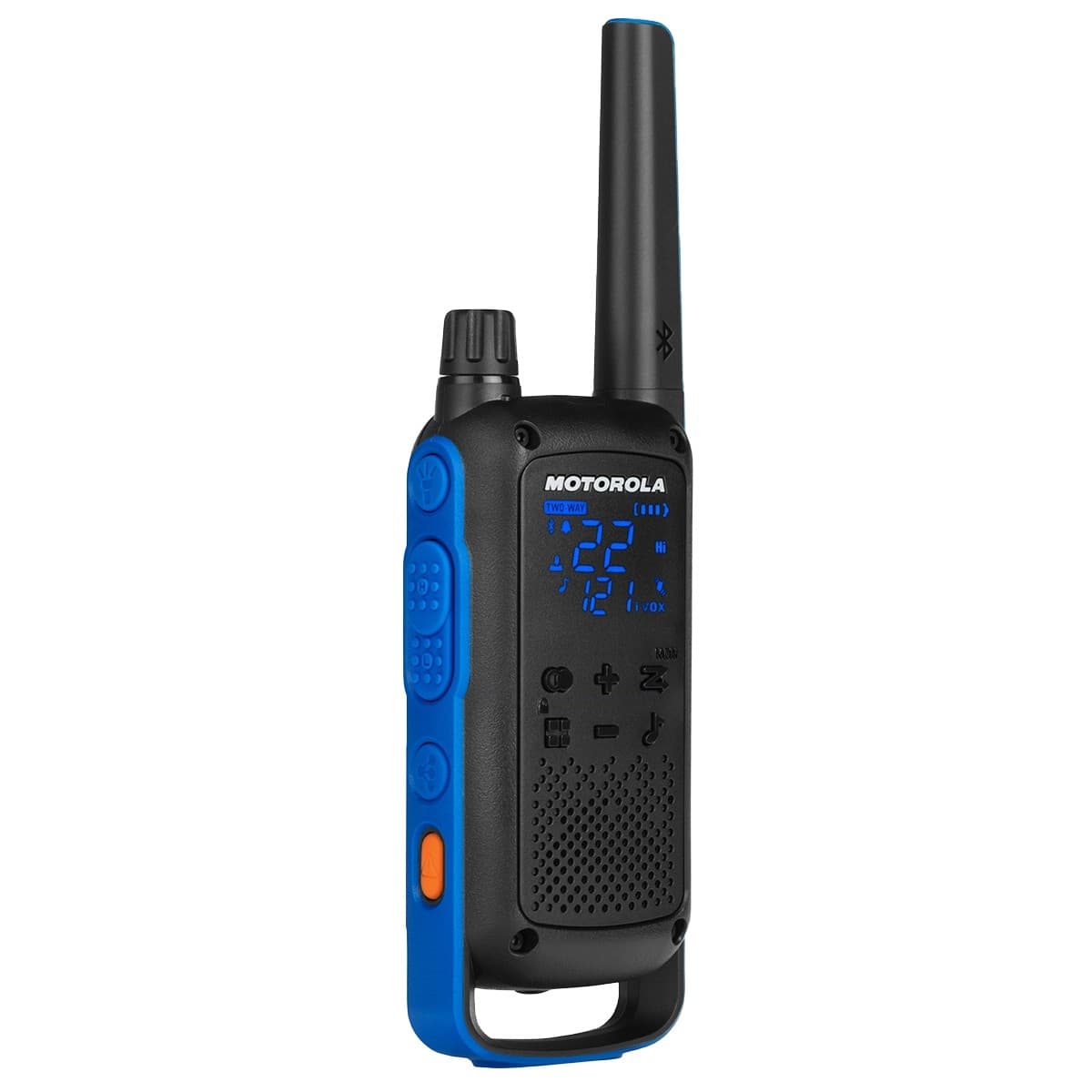
The Motorola T800 is a capable pair built for exactly that. It keeps a household connected during an evacuation, a neighborhood emergency, or any time the phones are useless, and it adds the things that matter when the power's out too: NOAA weather alerts, a rugged, weather-resistant body, and USB-C charging so you're not hunting for proprietary cables. The range claims on the box are fantasy, and we'll be honest about that — but for keeping your people in touch when the network can't, a set of these in the kit is genuine peace of mind that works the moment you turn them on.
How We Evaluated
How we evaluated this
We researched this the same way we'd size up a set before buying it for our own family: manufacturer specs, how the technology actually behaves, and real owner reviews. We started with the spec these radios are most often oversold on — range. The '35-mile' figure is a line-of-sight, mountaintop-to-mountaintop number, so we checked it against how FRS/GMRS radios really perform once buildings, trees, and terrain get in the way: more like one to two miles in a suburb. We confirmed the features that genuinely earn their keep — the NOAA weather channels and alerts, the IPX4 weather-resistance rating, the USB-C rechargeable batteries, and the 22 channels with privacy codes.
Then we read widely through verified owner reviews and prepping and overlanding discussion for the real-world truths: the range people actually get in their neighborhoods, the battery life, and the finicky Bluetooth app pairing that comes up again and again. We haven't run our own range tests across town yet — but between how the radio tech works and what owners report, we can tell you what range to actually expect, which features matter, and who these are right for.
Our pick: Motorola T800 Talkabout Two-Way Radio (2-pack)
The verdict
A rugged way to keep your family in touch when cell towers go down. IPX4 weather resistance and USB-C charging make it practical; just treat the 35-mile range as marketing and expect a mile or two in the suburbs.
- IPX4 weather-resistant — handles rain and splashes
- USB-C charging — no proprietary cables
- NOAA alerts built in
- 35-mile range is marketing max — expect 1-2 miles in suburbs
- App connectivity is inconsistent
What it does well
The T800's real value is independence from the network: it talks radio-to-radio, so it keeps working when cell towers are down, jammed, or simply absent. For a household coordinating during an evacuation, keeping tabs on each other in a neighborhood emergency, or staying in touch on a trip with no signal, that direct connection is exactly the gap a phone can't fill. It's quick — push a button and talk, no dialing, no network handshake — which is its own kind of reliability in a crisis.
Motorola built in the features that matter for emergencies, not just recreation. It receives NOAA weather channels with alerts, so the radios double as a weather warning source. The body is IPX4 rated — weather-resistant, able to shrug off rain and splashes, though not submersion — which is valuable in gear meant for storms. It charges over USB-C, so you can top it up from the same cables and power banks as everything else (no proprietary brick to lose), and the rechargeable packs are decent on runtime. The 22 channels plus privacy codes make it easy to find a clear conversation, and the build feels rugged enough to take a beating. For network-free family comms, it's a well-rounded set.
What it does poorly
The range is the big honest asterisk. The '35-mile' rating is pure line-of-sight marketing — achievable only between two mountaintops with nothing in between — and in the real world, where buildings, hills, and trees absorb the signal, you should expect more like one to two miles in a suburb and less in dense terrain. That's still useful for a neighborhood or a campsite, but if you bought them imagining cross-town coverage, you'll be let down. The Bluetooth app, which promises hands-free use and texting, is the other weak point: owners frequently call its pairing and reliability finicky, so don't count on it as a core feature. The radios are also FRS-class for unlicensed use, which caps their power; squeezing more range legally means GMRS and a license. And two-way radios only help if everyone has one and it's charged.
Where it shines
Keeping a family or a small group connected over short distances when the network is gone — evacuations, neighborhood coordination, campsites, and convoys. The NOAA alerts and weather-resistant build make them especially fitting for storm scenarios, where they're both a comms tool and a weather radio.
Where it frustrates
Believe the box's range and you'll be frustrated the first time a few blocks of houses cut you off — set expectations at a mile or two. And if you were counting on the app for texting or hands-free, its inconsistency will annoy you. Treat them as solid short-range, network-free radios with a good weather feature, and they deliver.
Other options to consider
A licensed GMRS radio (e.g., Midland MXT series)
More real range — at the cost of a license and setup. GMRS radios can legally transmit at higher power and, with a proper antenna, reach much farther than FRS handhelds like the T800. The trade is a (cheap, no-test) FCC license and more gear to set up. For people who need real distance, GMRS is the upgrade; for simple grab-and-go family comms, the T800 is plug-and-play.
Baofeng programmable radios
Far cheaper and more powerful — but a steep learning curve and legal gray area. Programmable radios offer more power and flexibility for very little money, but they're complicated to set up, easy to use on the wrong frequencies, and require a license to transmit legally on many bands. For most households that just want radios that work out of the box, the T800's simplicity is worth more than the Baofeng's power.
Relying on cell phones with offline or satellite features
Convenient, but not a true network-free substitute. Newer phones add satellite SOS and offline maps, which help, but they're for emergencies and dead zones, not casual back-and-forth, and they still depend on your phone's battery and a clear view of the sky. Radios give instant, repeatable, push-to-talk contact within a short range regardless of any network. They complement phones rather than replace them.
Longevity
How long will this actually last
The T800's lifespan comes down to its rechargeable battery, as with most electronics — that's the part most likely to weaken over the years, especially if the radios sit fully drained for long stretches. The good news is the T800 hedges this two ways: the packs charge over standard USB-C (so no proprietary charger to lose), and the radios can also run on regular AA batteries in a pinch, which means a tired rechargeable pack never leaves you without comms in an emergency.
To get the most battery life, top the radios off every few months while they're in storage rather than letting them sit empty, and keep them out of extreme heat, which ages cells fastest. The IPX4-rated body resists the rain and splashing water that kill lesser radios, so the housing itself is durable; the buttons and the charging port are the mechanical parts most likely to wear with heavy use. There's nothing to service. The practical routine: store them charged with a set of spare AAs alongside, test them a couple of times a year to confirm they still pair and transmit, and replace the battery packs if runtime drops off after a few years. Kept charged and dry, a set should be ready for many emergencies.
Questions people actually ask
What range will I really get — is it actually 35 miles?
Do they work when cell towers are down?
How water-resistant are they?
How do they charge, and what if the battery dies?
Is the Bluetooth app worth using?
Technical Specifications
| Channels | 22 |
| Charging | USB-C |
| Bluetooth | true |
| Water Resistance | IPX4 |
| Privacy Codes | 121 |
| Range Miles Open | 35 |