Who this is for
Every go-bag and car kit — cheap, tiny insurance against an unexpected cold night.
Skip if
Comfortable shelter for multiple nights — get a real sleeping bag.
Preparedness Gear
Tact Bivvy 2.0 Emergency Sleeping Bag
Evaluated for household use · Affiliate links disclosed
Palm-sized reflective warmth for the car and the go-bag — reusable, unlike a mylar blanket
Why we chose it
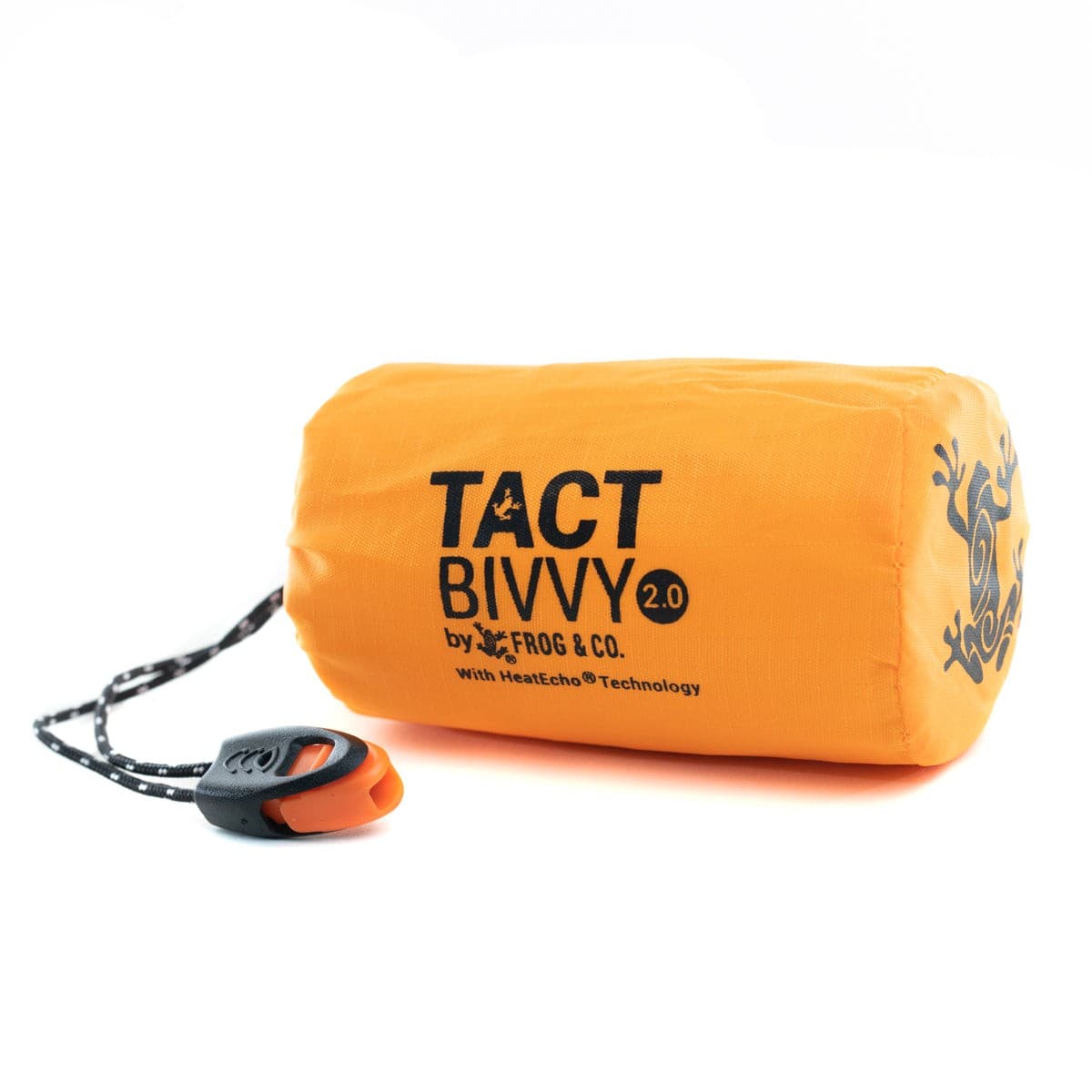
At about 4.8 oz it packs smaller than a wallet and reflects most of your body heat back at you, and unlike a single-use mylar blanket you can reuse it — emergency warmth you can keep in every bag.
Buy From
Survival FrogAffiliate links · We earn a small commission at no cost to you. How this works
We evaluate every pick for real-world reliability.
Why this matters
Why this matters in an emergency
Cold is a quiet danger. You don't have to be on a mountain for it to be a problem — a car that breaks down on a winter night, a power outage during a cold snap, an evacuation that leaves you waiting outside for hours. The body loses heat fast once you stop moving, and hypothermia sets in long before most people expect.
The Tact Bivvy is a tiny answer to that big risk: an emergency sleeping bag, about the size of your palm and the weight of a few slices of bread, that reflects most of your body heat back at you to keep you warm in serious cold. Unlike the crinkly mylar 'space blankets' people stuff in kits and never trust, this one is durable and reusable, and it actually works as a full bag you climb inside. It's cheap enough and small enough to keep one in every car and every bag — and it's the kind of thing you forget about completely until the night it matters.
How We Evaluated
How we evaluated this
We researched this the way we'd vet any emergency shelter: against its specs, the physics of how it works, and what owners report after real use. We looked at the claims that matter for a bivvy — that it reflects up to about 90% of body heat, the packed size and weight (genuinely palm-sized at about 4.8 ounces), the waterproofing, and the reusable design that sets it apart from single-use mylar — and cross-referenced those against the manufacturer's specs and how reflective emergency shelters actually work: they trap and reflect radiant body heat rather than generating warmth, which shapes what they can and can't do.
Then we read widely through verified owner reviews — this is a hugely popular kit item — for the lived-in truths: the condensation that builds up inside any reflective bivvy, how the material holds up to repeated use versus disposable mylar, and how warm people actually feel using it in the cold. And we read go-bag and car-kit discussion about where it fits. We haven't spent a freezing night in one — but between how the technology works and what owners report, we can tell you exactly what it does well, the condensation trade-off, and why it belongs in your kit.
Our pick: Tact Bivvy 2.0 Emergency Sleeping Bag
The verdict
A palm-sized insurance policy for any bag. It reflects most of your body heat, packs smaller than a wallet, and unlike single-use mylar, you can use it again.
- Packs smaller than a wallet
- Reusable unlike mylar blankets
- Reflects most of your body heat back at you
- Condensation builds up inside
- Not comfortable for sleeping
What it does well
The Tact Bivvy gets the core job right: it keeps you warm, and it does it from almost no size or weight. The reflective material bounces up to around 90% of your body heat back at you, and because it's a full bag you climb inside rather than a flat blanket, that heat is trapped all around you instead of escaping out the sides. The payoff is real warmth in serious cold from something that packs down to about a 3-by-3-inch bundle and weighs about 4.8 ounces — small enough to genuinely live in a glovebox, a jacket pocket, or the bottom of any bag without you noticing it's there.
Its biggest advantage over the familiar mylar 'space blanket' is that it's durable and reusable. Cheap mylar tears almost immediately and is a one-time, crinkly mess; the Tact Bivvy's material is tougher, so you can use it, pack it up, and use it again, and it's waterproof and windproof, which matters because wet and wind are what make cold dangerous. For the price — genuinely low — and the size, the protection it offers is hard to argue with. It's the definition of cheap insurance.
What it does poorly
The honest trade-off is condensation, and it's inherent to how reflective bivvies work: by sealing heat in, they also seal moisture in, so your breath and body moisture condense on the inside and you wake up damp. That's not a defect — every reflective bivvy does it — but it's uncomfortable and worth knowing, and it means this is emergency gear, not a cozy night's sleep. It's also not a substitute for a real sleeping bag: there's no insulation, just reflection, so in extreme or prolonged cold it keeps you alive and far warmer than nothing, but it won't feel toasty. The single-layer material, while tougher than mylar, can still be punctured by sharp ground, so a pad or barrier underneath helps. And it's a snug bag, and like any thin reflective film the material crinkles — fine in an emergency, not luxurious.
Where it shines
Every go-bag, car kit, and emergency stash — the situations where you need warmth you can carry and forget. A stranded car on a winter night, an evacuation with hours of waiting, a power outage in the cold: this is exactly the gear that turns a dangerous chill into a survivable wait, at a size and price that make it easy to justify in every kit.
Where it frustrates
If you expect a comfortable sleep, the condensation and snug, crinkly fit will disappoint — it's survival gear, not camping comfort. And if you think of it as a sleeping bag rather than a heat-reflector, you may over-trust it in extreme cold, where you'd still want real insulation. Used for what it is — emergency warmth in a tiny package — it's superb.
Other options to consider
A single-use mylar emergency blanket
The cheap classic — better than nothing, worse in every other way. Mylar blankets cost almost nothing and weigh nothing, so a few in a kit is sensible backup, but they tear instantly, are a flat blanket rather than a bag, and are effectively single-use. The Tact Bivvy costs a little more and is dramatically more durable, reusable, and warmer as a full bag. Keep mylar as cheap backup; rely on the bivvy.
A real rated sleeping bag
Genuinely warm and comfortable — but bulky and heavy. A proper insulated sleeping bag is far more comfortable and warmer for prolonged cold, and it's the right choice for car camping or a home cold-weather kit where space allows. The trade is size and weight that don't fit a compact go-bag. Many people carry both: a real bag at home, the Tact Bivvy in the car and the pack.
An insulated or breathable bivvy sack
Warmer and breathable, at more size, weight, and cost. Insulated or breathable bivvies solve the condensation problem and add real warmth, but they cost much more and pack far larger, defeating the Tact Bivvy's whole point. For ultralight, cheap, forget-it-in-the-kit emergency warmth, the reflective bivvy wins; for comfort-focused use, an insulated option is better.
Longevity
How long will this actually last
For a few-ounce piece of emergency gear, the Tact Bivvy holds up well, and its durability is exactly what separates it from disposable mylar. The reflective material is tough enough to be used, repacked, and reused many times rather than tearing on first use, so a single bivvy can serve through years of being stashed and occasionally deployed. That said, it's not indestructible: the main thing that ends one is a puncture or tear from sharp ground, gear, or rough handling, so using a pad or a barrier underneath and not dragging it over rocks extends its life considerably.
Repeated hard use eventually wears the material and the seams, but for occasional emergency use that takes a long time. Storage is easy — it's waterproof and doesn't degrade sitting in a glovebox or pack — though extreme, prolonged heat (a baking summer trunk) can make any thin film material more brittle over years, so a climate-controlled kit lasts longer. The practical lifecycle: keep it in every bag, deploy it when needed, repack it carefully if it's undamaged, and replace it if it tears or the material starts to crack. At its price, replacing one is trivial — and keeping a spare mylar blanket as backup costs almost nothing.
Questions people actually ask
How warm does it actually keep you?
Is it reusable, or one-time like a space blanket?
Why do I wake up damp inside it?
Can it replace a real sleeping bag?
Where should I keep one?
Technical Specifications
| Material | HeatEcho reflective film |
| Reusable | true |
| Weight Oz | 4.8 |
| Packed Size | 3x3 inches (packed) |
| Heat Reflection | up to 90% (manufacturer claim) |
Sources we consulted
We may earn a commission when you buy through links on this page. How this works
Preparedness Gear
Tact Bivvy 2.0 Emergency Sleeping Bag
Evaluated for household use · Affiliate links disclosed
Palm-sized reflective warmth for the car and the go-bag — reusable, unlike a mylar blanket
Why we chose it
At about 4.8 oz it packs smaller than a wallet and reflects most of your body heat back at you, and unlike a single-use mylar blanket you can reuse it — emergency warmth you can keep in every bag.
Buy From
Survival FrogAffiliate links · We earn a small commission at no cost to you. How this works
We evaluate every pick for real-world reliability.