Who this is for
Every household — the baseline everyone should have before upgrading.
Skip if
Trauma capability — get the MyMedic instead.
Why this matters
Why this matters in an emergency
Most injuries in an emergency aren't dramatic. They're the small, ordinary ones that pile up when normal life is disrupted: a cut from clearing storm debris, a burn from cooking on a camp stove, a blister from walking when you can't drive, a scrape that needs cleaning before it gets infected. When the power's out or the roads are closed, even minor injuries are harder to deal with — and a trip to urgent care may not be an option.
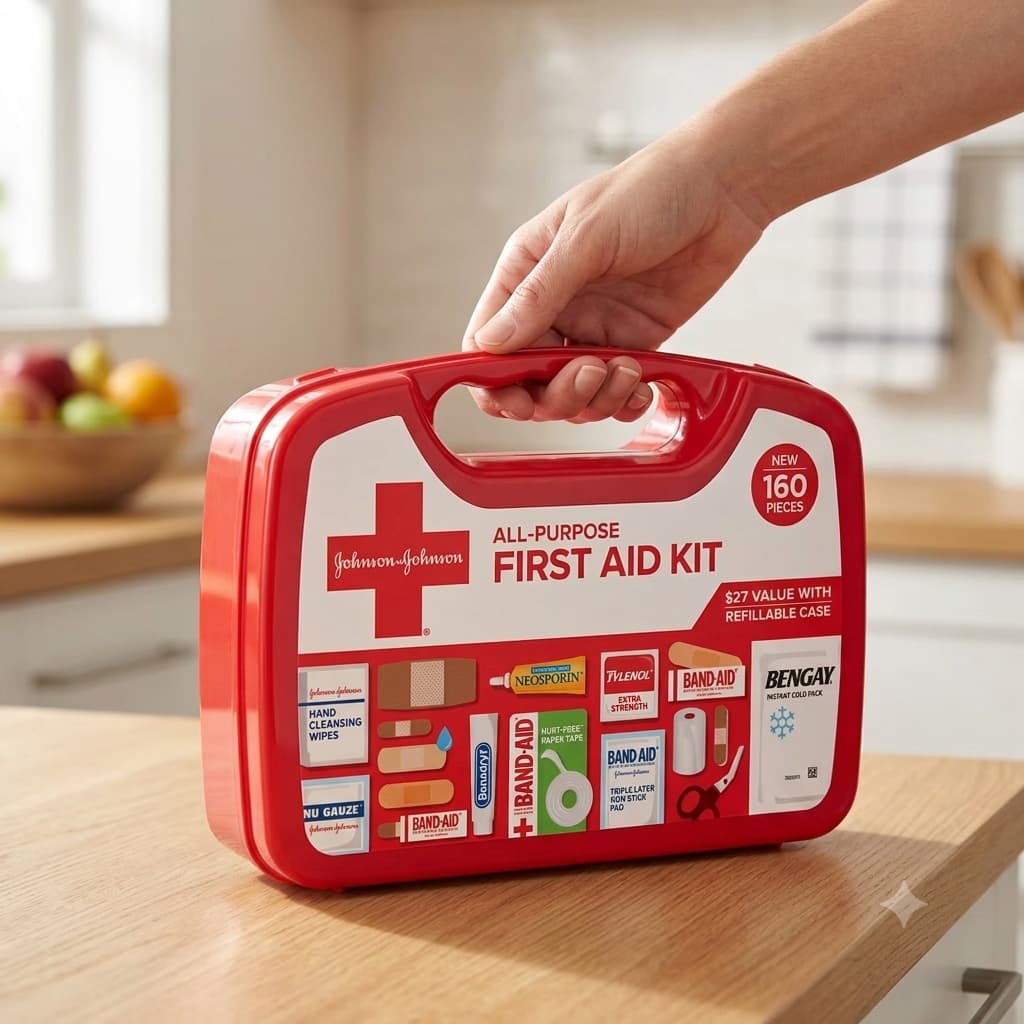
A good basic first aid kit handles the everyday injuries that are annoying rather than life-threatening — the great majority of them, so a small problem stays small. The Johnson & Johnson 160-piece kit is the sensible baseline every household should own before anything fancier: bandages in every size, antiseptics, gauze, and a first-aid guide, organized in a case you can find in a hurry. It won't handle major trauma — that's a different kit — but for the everyday cuts, burns, and scrapes that make up most of what actually happens, it's exactly enough.
How We Evaluated
How we evaluated this
We researched this the way you'd judge any first-aid kit: by what's actually in the box, not the piece count on the front. Piece counts can be padded with dozens of identical small bandages, so we inventoried the 160-piece kit against its contents list for the range that matters — adhesive bandages in useful sizes, gauze, antiseptic wipes, burn treatment, tape, and a usable guide. We confirmed it's the genuine Johnson & Johnson product, which matters for a brand people trust to restock, and noted what it deliberately leaves out — no tourniquet, no trauma supplies.
Then we read widely through verified owner reviews for the practical truths: whether the case organizes well or everything shifts into a jumble, the quality of the adhesives and wipes, and how people actually use it day to day. And we cross-referenced basic first-aid guidance from the CDC on what a household kit should cover. We haven't treated real injuries with it — but between the inventory and the owner reports, we can tell you exactly what this kit handles, where it stops, and what you'd add to cover the gaps.
Our pick: Johnson & Johnson All-Purpose First Aid Kit (160 pieces)
The verdict
The baseline every household should own. It covers the cuts, burns, and sprains that make up the vast majority of home injuries — just don't expect trauma-level capability.
- Trusted brand, widely available for restocking
- Good for minor injuries — covers most situations
- Affordable baseline
- No tourniquet
- No trauma-level supplies
What it does well
The Johnson & Johnson 160-piece kit gets the basics right, which is most of what a household kit needs to do. It covers the everyday injuries — cuts, scrapes, burns, blisters, splinters — with adhesive bandages in a useful range of sizes, gauze pads, antiseptic and cleansing wipes, and tape, plus a first-aid instruction guide for the moments you're not sure what to do. It's a genuine Johnson & Johnson product, which matters more than it sounds: it's a brand you trust, and the supplies are the same ones you can restock at any drugstore, so the kit stays useful instead of becoming a sealed box of mystery components.
It's affordable and approachable, which is the point of a baseline. Everything lives in a hard plastic organizer case that keeps supplies sorted and findable — important when you're flustered and someone's bleeding — and it's compact enough to keep in a kitchen, a car, and a bag without thinking about it. For the overwhelming majority of injuries a household actually faces, especially during the disruptions where a quick clinic visit isn't easy, it has what you'll reach for.
What it does poorly
Be clear-eyed about its ceiling: this is a minor-injury kit, not a trauma kit. There's no tourniquet, no hemostatic gauze, no chest seal, no Israeli bandage — none of the gear that stops serious, life-threatening bleeding. For a deep wound or a major accident, it's not the kit you need, and pretending otherwise is dangerous. The piece count is also a bit of marketing: a chunk of those 160 pieces are identical small bandages, so the '160' sounds more comprehensive than the actual range of capabilities is. And the case, while handy, can let smaller items shift around over time. None of that makes it a bad kit — it makes it a baseline kit, which is exactly what it's sold as.
Where it shines
As the everyday household first aid kit every home should have — kitchen, car, go-bag — handling the constant low-level injuries of normal life and the extra ones that come with a disruption. It's the kit you actually open a dozen times a year, which is the best argument for owning a good basic one.
Where it frustrates
If you're expecting it to handle a real emergency injury — a deep laceration, a serious bleed — it can't, and counting on it for that is the real risk. Treat it as your baseline and pair it with trauma capability, and it does its half of the job well.
Other options to consider
MyMedic MyFAK
Our trauma pick — the kit for the injuries this one can't touch. Where the J&J kit stops at scrapes and burns, the MyFAK adds trauma dressings, hemostatic gauze, and a compression bandage for serious bleeding — though the Standard itself ships without a tourniquet, so pair it with one (a CoTCCC-recommended CAT) for full trauma readiness. It's pricier and overkill for paper cuts, but it's what you want when an injury is genuinely dangerous. The two are the two layers most households should own — baseline plus trauma.
Read full review →Surviveware larger first aid kit
A bigger kit with higher piece counts and nicer organization. These pad the count with more of the same basic supplies and sometimes better organization, but most still lack real trauma gear. If you want a slightly more complete basic kit, they're fine; just don't mistake a high piece count for trauma capability — that's a different category.
Building your own from drugstore supplies
Often cheaper and exactly what you use. A box of the bandages, antiseptic, gauze, and tape your family actually reaches for can beat a pre-made kit on cost and fit. The trade is the time to assemble it and a container to organize it. The J&J kit's advantage is that it's ready-made, organized, and cheap enough that building your own rarely saves enough to bother.
Longevity
How long will this actually last
A first aid kit doesn't wear out so much as expire and deplete, and that's the key to thinking about its lifespan. The case and tools last indefinitely, but the consumables have shelf lives: antiseptic and cleansing wipes dry out over a few years, adhesive bandages lose their stick as the adhesive ages, and any ointments or medications have printed expiration dates. So the 'maintenance' is really restocking — check the kit once or twice a year, toss anything dried out or expired, and refill whatever you've used, which is easy precisely because these are standard drugstore supplies you can buy anywhere.
Heat and humidity speed the decline, so a climate-controlled spot beats a hot car trunk for the main kit (a car kit just needs more frequent checks). The hard case protects the contents and should outlast many refills. Treat it as a living kit you top up rather than a sealed box you buy once and forget, and it stays genuinely useful for decades — the supplies cycle through, the kit endures. The worst first aid kit is the one with three dried-out wipes and no bandages because no one checked it.
Questions people actually ask
Is this enough for a household emergency kit?
Does it include a tourniquet or anything for serious bleeding?
Are 160 pieces as comprehensive as it sounds?
How do I keep it ready to use?
Should I keep more than one?
Technical Specifications
| Case | Hard plastic organizer |
| Pieces | 160 |
| Includes Guide | true |