Who this is for
High-risk water emergencies, households utilizing questionable rainwater, or properties in flood zones.
Skip if
Light outdoor travel or compact go-bags.
Preparedness Gear
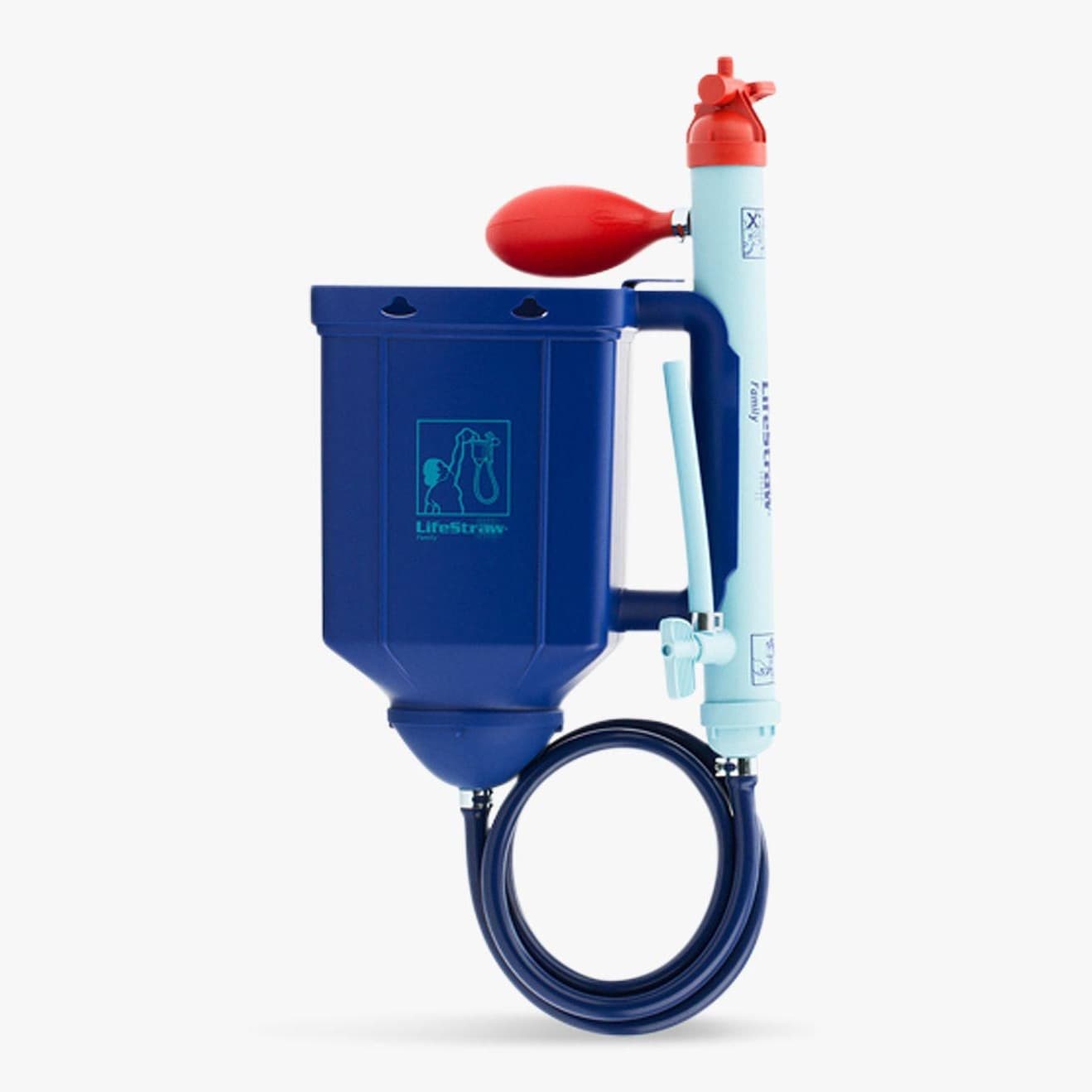
LifeStraw Family 1.0 Gravity Powered Water Purifier
Evaluated for household use · Affiliate links disclosed
Built for flood zones and virus-risk areas
Why we chose it
When flooding mixes sewage into the water supply, a standard 0.1-micron filter isn't enough. The LifeStraw Family filters down to 0.02 microns — fine enough to remove viruses too, not just bacteria and protozoa. It's one of the few portable purifiers that does, which is why we reach for it when the water could carry sewage.
Buy From
LifeStrawAffiliate links · We earn a small commission at no cost to you. How this works
We evaluate every pick for real-world reliability.
Why this matters
Why this matters in an emergency
Most water emergencies are a bacteria-and-parasite problem, and a basic filter handles those. But some emergencies are worse. When a flood pushes sewage into the water supply, or you're relying on rainwater or a questionable source after a hurricane, viruses enter the picture — and viruses are small enough to slip through an ordinary filter. That's the gap the LifeStraw Family is built to close.
It's a gravity-powered purifier that strains water down to 0.02 microns, fine enough to physically block viruses along with the bacteria and parasites everything else catches. The WHO's testing scheme rates the LifeStraw Family as giving "comprehensive" protection — its top tier, for water of unknown quality — and it's built to meet the US EPA's standard for water purifiers, the bar that separates a true purifier from a filter. You hang it up, pour dirty water in the top, and clean water drips out the bottom — no pumping, no power, no chemicals. For a household in a flood-prone or hurricane-prone area, or anyone that wants the highest level of water safety without batteries, it's one of the few filters that covers the worst-case source. It's slower and bulkier than a pocket filter — but it protects against things a pocket filter can't.
How We Evaluated
How we evaluated this
We researched this the way a virus claim deserves to be checked: against the spec that defines the product, the standards behind it, and what owners report after real use. The headline is the 0.02-micron filtration that lets it remove viruses, not just bacteria and protozoa — so we cross-referenced LifeStraw's claims against independent lab testing and the EPA and WHO drinking-water standards the company cites, because "removes viruses" is a serious claim that deserves verification, not a nod. We confirmed what it is and isn't: a purifier (viruses included), where most portable filters are only filters.
Then we read widely through verified owner reviews and long-term reports for the lived-in truths — the slow flow rate, the mildew that grows in the hoses if you don't dry it, the real capacity before it clogs — and we read flood-recovery and prepper discussion about when virus-level protection actually matters. We haven't cultured the output water ourselves; the 0.02-micron rating and the independent WHO and EPA evaluations are well documented, and between those and the owner reports, we can tell you when this purifier is the right tool, when it's overkill, and how to keep it working.
Our pick: LifeStraw Family 1.0 Gravity Powered Water Purifier
The verdict
The LifeStraw Family is a true water purifier, not just a filter. Because its hollow-fiber pores are about five times tighter (0.02 microns) than a standard filter, it removes viruses as well as bacteria and protozoa — independently rated "comprehensive" protection by the WHO scheme. That makes it our recommended option for flood zones or sewage-contaminated tap water, not everyday backcountry trips.
What it does well
The LifeStraw Family does something most filters its size can't: it removes viruses. Its hollow-fiber membrane filters down to 0.02 microns — about five times finer than the 0.1-micron filters that define the category — and that extra fineness is what physically blocks viruses like norovirus, rotavirus, and hepatitis A, on top of the bacteria and protozoa every good filter catches. The WHO's testing scheme rates the LifeStraw Family as giving "comprehensive" protection — its top tier — and it's built to meet the US EPA's standard for water purifiers, the bar that separates a true purifier from a filter. For flood water, sewage-contaminated supply, or sketchy rainwater, that's the difference between safe and a gamble.
It's also refreshingly simple. It runs on gravity — hang it from a hook, a branch, or a nail, pour unfiltered water into the top reservoir, and clean water flows out the bottom. No pumping, no batteries, no chemicals, nothing to run out of. Capacity is enormous: it's rated to purify thousands of gallons over its life, enough to carry a household through a very long emergency. And it has a built-in backflush tap to clear sediment and restore flow, so it keeps working through dirty water that would clog a lesser filter.
What it does poorly
The price of that 0.02-micron fineness is speed. Water has to work through a much tighter membrane, so the flow is noticeably slower than a 0.1-micron filter — you're hanging it up and letting it drip, not filling a bottle on demand. The setup is also bulkier: it's a hanging tower with a hose, not something you slip in a pocket, so it's a home or basecamp tool, not a go-bag filter. And the hose and reservoir need to be dried out properly after use, because owner reviews are clear that mildew will grow inside if you pack it away wet. It's mid-range in price, more than a simple squeeze filter, which only makes sense if you actually need the virus protection.
Where it shines
Flood zones, hurricane country, and anywhere the water supply could be contaminated by sewage — the situations where ordinary filters fall short. It's also excellent as a household's main high-volume water source during a long advisory, steadily producing clean water for a family with no effort beyond refilling the top.
Where it frustrates
If you grabbed it expecting quick, on-demand water, the slow drip will test your patience — it rewards setting it up and walking away. And if you pack it away damp, you'll find mildew next time, so the drying step isn't optional. It's the right tool for the worst water, and overkill for a simple boil advisory.
Other options to consider
Sawyer Squeeze
Our overall water pick — lighter, faster, cheaper, but a filter, not a purifier. The Sawyer removes bacteria and protozoa brilliantly at a fraction of the size and price, and for most boil advisories that's all you need. Choose the LifeStraw Family instead only when viruses are a real risk — flooding, sewage, questionable rainwater — which the Sawyer can't handle alone.
Read full review →A Berkey-style countertop gravity filter
A countertop gravity filter many households like for everyday use. It's a capable daily filter, but it's bulkier and built for kitchen-counter use rather than emergency portability. For dedicated, portable virus protection, the LifeStraw Family is the more travel-ready choice.
Aquatabs (chlorine-based tablets)
Not a filter at all, but the other way to kill viruses — and a great companion. Tablets handle viruses and bacteria chemically and weigh almost nothing, but they don't remove sediment, some parasites resist them, and the water can taste of chemicals. They're a superb backup to pair with a filter; the LifeStraw does the physical removal in one step.
Read full review →
You might also like
Longevity
How long will this actually last
The LifeStraw Family is built to last through a serious, prolonged emergency: its membrane is rated by LifeStraw to purify roughly 18,000 liters — about 4,750 gallons — which for most households is years of heavy use or a single very long disaster. The key to reaching that number is the built-in backflush tap; running clean water backward through the filter clears the sediment that slows it down and restores the flow, so it doesn't clog its way to an early death.
The thing that actually shortens its life isn't use, it's storage. Like all hollow-fiber filters, it must never freeze while wet — ice cracks the fibers and invisibly destroys the virus protection with no visible sign. And it must be dried out before storage, or mildew grows in the hose and reservoir. So the routine is simple: after use, backflush it, drain and air-dry the components fully, and store it somewhere that won't freeze. Do that and it's a multi-year, buy-it-for-the-worst-case purchase; neglect the drying or let it freeze, and you can ruin it in one off-season.
Questions people actually ask
Does the LifeStraw Family really remove viruses?
When do I actually need virus protection versus a regular filter?
How slow is it, really?
What kills it — how do I avoid ruining mine?
Can I use it for a whole family during a long emergency?
Technical Specifications
| Weight | 1.17 lb / 0.53 kg (LifeStraw) |
| Capacity | ~18,000 L / 4,750 gal (manufacturer) |
| Flow Rate | ~8.8–12 L/hr with a clean filter (E4C / LifeStraw) |
| Pore Size | 0.02 micron (20 nm) hollow-fiber ultrafiltration |
| Pre Filter | 80-micron textile pre-filter (E4C/WHO) |
| Virus Removal | WHO scheme: "comprehensive" protection; LifeStraw rates 99.999% (Log 5) |
| Bacteria Removal | ≥99.9999% / ≥6-log (E4C/WHO); LifeStraw rates 99.999999% |
| Protozoa Removal | ≥99.99% / ≥4-log (E4C/WHO); LifeStraw rates 99.999% |
| Power | Gravity only — no electricity, batteries, or pumping |
| Filter Type | Hollow-fiber gravity ultrafiltration purifier |
Sources we consulted
We may earn a commission when you buy through links on this page. How this works
Preparedness Gear
LifeStraw Family 1.0 Gravity Powered Water Purifier
Evaluated for household use · Affiliate links disclosed
Built for flood zones and virus-risk areas
Why we chose it
When flooding mixes sewage into the water supply, a standard 0.1-micron filter isn't enough. The LifeStraw Family filters down to 0.02 microns — fine enough to remove viruses too, not just bacteria and protozoa. It's one of the few portable purifiers that does, which is why we reach for it when the water could carry sewage.
Buy From
LifeStrawAffiliate links · We earn a small commission at no cost to you. How this works
We evaluate every pick for real-world reliability.