Who this is for
Go-bags, individual emergency kits, budget storage baselines, and light evacuation plans.
Skip if
Households needing high-volume daily cooking and cleaning water.
Preparedness Gear
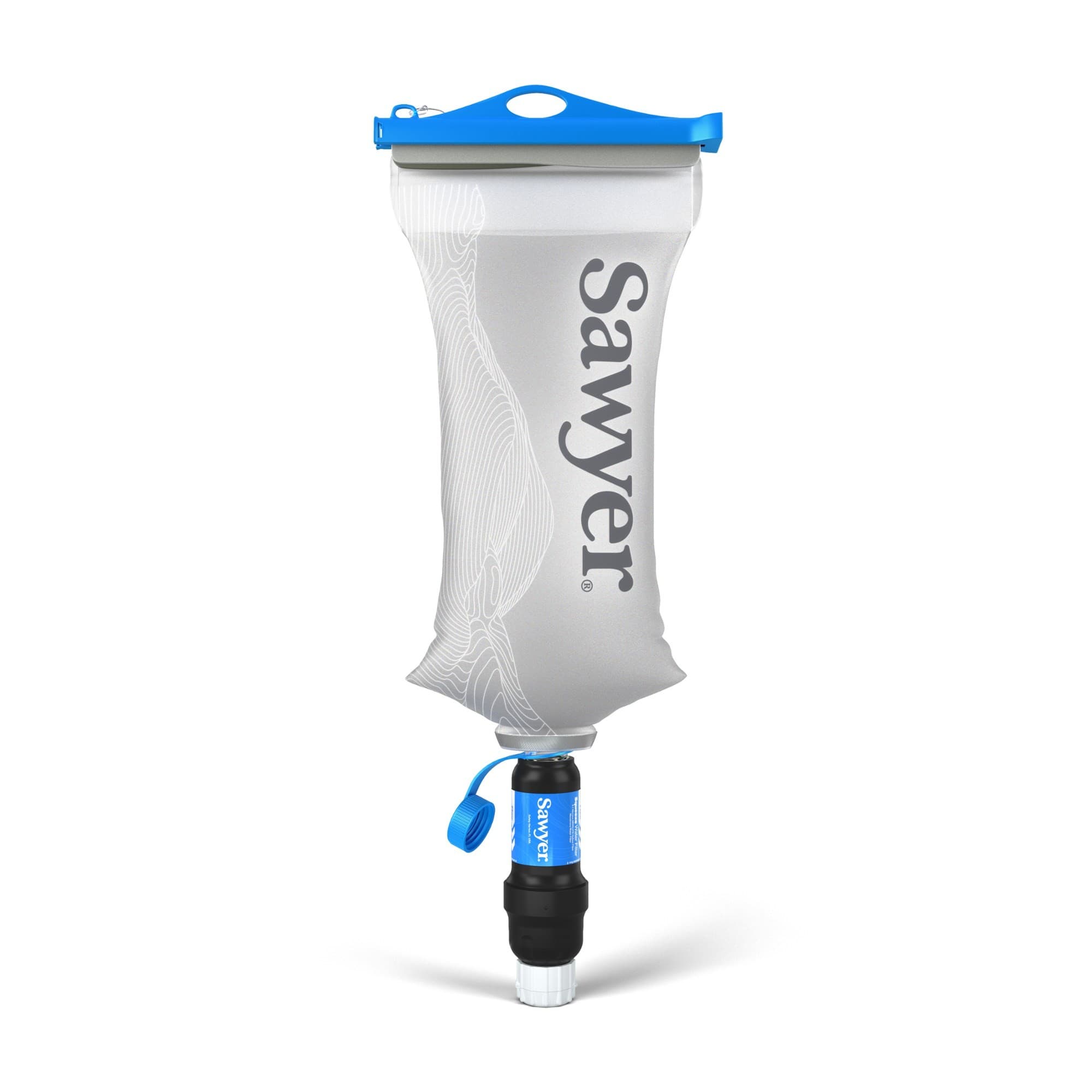
Sawyer Squeeze Water Filtration System
Evaluated for household use · Affiliate links disclosed
A reliable pick for go-bags and individual kits
Why we chose it
Three ounces, a lifetime warranty, and the ability to screw onto any standard water bottle — about as simple and dependable as a personal filter gets.
Buy From
SawyerAffiliate links · We earn a small commission at no cost to you. How this works
We evaluate every pick for real-world reliability.
Why this matters
Why this matters in an emergency
When the tap turns unsafe — a boil advisory, a main break, floodwater in the system — the thing you suddenly can't take for granted is a glass of water you trust. Storing water covers you for a few days. But if a disruption stretches past your jugs, or you're away from home when it hits, you need a way to make water safe on the spot.
That's what the Sawyer Squeeze is for. It's a filter the size of a travel deodorant that screws onto a water bottle and turns creek water, rain-barrel water, or questionable tap into something you can hand a kid without worrying. It won't help with chemical spills or viruses, and we'll be clear about that below. But for the most common water problem most households will ever face — bacteria and parasites in the supply — it's the cheapest, lightest insurance you can buy. It sits in a junk drawer doing nothing until the day you're very glad it's there.
How We Evaluated
How we evaluated this
We bought this one and we've actually filtered water with it — that's the honest baseline here, not a spec sheet read aloud. We ran tap water and cloudy creek water through it, screwed it onto a standard SmartWater bottle the way most people end up using it, and squeezed until our hands got tired to get a feel for the flow and the effort. We backflushed it with the included syringe after it silted up to confirm the flow really does come back, and we checked how it behaves in cold water — slower — and read the fine print on what freezing does to it.
Then we did the normal homework on top of that. We cross-referenced Sawyer's 0.1-micron hollow-fiber claim against independent filter testing to confirm it removes what it says it does — bacteria and protozoa, not viruses — and we read through a pile of long-term owner reports. Because the question that matters for a filter isn't ‘does it work new,’ it's ‘does it still flow after a year of backwashing.’ What we didn't do is lab-culture the output water; we're not a testing lab, and the 0.1-micron rating is well established. What we can tell you is what it's actually like to live with — the part the box never mentions.
Our pick: Sawyer Squeeze Water Filtration System
The verdict
A high-value pick for any kit. Lightweight, durable, and — per Sawyer's ratings — filtering out 99.99999% of bacteria and 99.9999% of protozoa, it's a high-utility choice on a budget.
- Removes 99.99999% of bacteria and 99.9999% of protozoa
- Rated to 100,000 gallons — essentially lifetime use
- Ultralight at 3 oz (filter only)
- Backflushable with included syringe for full flow restoration
- Fits standard 28mm water bottle threads (Nalgene, SmartWater, etc.)
- Does not remove viruses — supplement with Aquatabs in high-risk flood zones
- Squeeze pouches wear out faster than the filter under heavy use
- Flow rate drops significantly in cold water (below 40 degrees F)
- Gravity adapter sold separately for hands-free camp-style use
What it does well
The Sawyer Squeeze gets the fundamentals exactly right, which is why it's been the quiet standard for years. It's tiny — about three ounces, the size of a travel bottle — and it screws straight onto standard plastic water-bottle threads, including the SmartWater bottles a lot of people already reach for. That detail matters more than it sounds: it means your ‘filter system’ is really just the filter and a bottle you already own.
The filtration is the real thing. The 0.1-micron hollow-fiber membrane physically strains out bacteria and protozoa — the giardia and cryptosporidium that ruin a trip or a recovery — at 99.9999% and better, a rating that holds up in independent testing. Flow is genuinely good when the filter's clean; you're not standing there forever to fill a bottle. And when the flow slows from sediment, you don't toss it — you backflush it with the included syringe and it comes back close to new. Sawyer rates it for an enormous volume over its life, which is why ‘buy it once’ is a fair way to think about it.
What it does poorly
Two honest limits. First, it does not remove viruses — the pores that catch bacteria are too big to stop something as small as norovirus. In North American tap and backcountry water that's usually a non-issue, but after a flood or a sewage event you'd want to add chemical treatment. Second, the squeeze pouches it ships with are the weak link; squeeze them hard enough and they can split at the seams. Most experienced users quietly retire the pouches and run it on a SmartWater bottle instead. Flow also drops noticeably in very cold water, and — this is the one that ruins filters — if you let it freeze while wet, ice cracks the hollow fibers and it's done, silently, with no way to tell.
Where it shines
A go-bag, a car kit, or a boil advisory that outlasts your stored water. Anywhere you need to make a lot of questionable water drinkable, cheaply, with nothing to plug in and nothing to run out of.
Where it frustrates
Filling water for a whole family by hand, one squeeze at a time, gets old fast — that's a job for a gravity setup, not a squeeze filter. And if you don't know about the freezing rule, you can kill it over one winter in the garage without ever realizing why it stopped working.
Other options to consider
LifeStraw Personal
The famous one, and it works — but it's more limited than it looks. You can only drink directly from the source through it; you can't easily fill a pot, a bottle, or a gravity bag, and it can't be backflushed, so it silts up for good. Great as a backup straw, not as your main filter.
Katadyn BeFree
Faster flow and a nicer feel in the hand — a real pleasure to use. The soft flask wears out faster and the filter has a shorter rated lifespan, so you're replacing parts sooner. We'd take the Sawyer's longevity over the BeFree's comfort for gear that mostly sits in storage.
Sawyer MINI
The Squeeze's little sibling — cheaper and even smaller. Same great filtration, but the flow is meaningfully slower and it clogs faster, which gets frustrating fast. The few dollars you save aren't worth the extra squeezing — get the full-size Squeeze.
You might also like
Longevity
How long will this actually last
This is where the Sawyer earns its keep. Sawyer rates the filter for around 100,000 gallons — effectively a lifetime of household use — and the reason it lasts is that you can clean it. When the flow slows, you backflush it with the included syringe, and owners a decade in report it still runs. So the filter itself rarely needs replacing.
What does wear out is everything around it: the squeeze pouches split with hard use (cheap to replace, or skip them for a SmartWater bottle), and the syringe and gaskets can get lost or brittle. The one thing that actually kills a Sawyer is freezing it while wet — ice expands inside the hollow fibers and cracks them, with no warning, just water that no longer gets filtered. So the storage rule is simple: after use, backflush it, shake it out, and keep it somewhere that won't freeze. Stored dry and above freezing, it'll outlast almost anything else in your kit, and a replacement filter is cheap on the rare chance you need one.
Questions people actually ask
How long will the Sawyer Squeeze last before I need to replace it?
Does it remove viruses?
Can I attach it to a regular water bottle?
What happens if it freezes?
Is the bigger Squeeze worth it over the cheaper Sawyer MINI?
Technical Specifications
| Weight | 3 oz |
| Capacity | Lifetime Guarantee |
| Flow Rate | 1.7 L / min |
| Pore Size | 0.1 microns |
| Filter Type | Hollow Fiber Membrane |
We may earn a commission when you buy through links on this page. How this works
Preparedness Gear
Sawyer Squeeze Water Filtration System
Evaluated for household use · Affiliate links disclosed
A reliable pick for go-bags and individual kits
Why we chose it
Three ounces, a lifetime warranty, and the ability to screw onto any standard water bottle — about as simple and dependable as a personal filter gets.
Buy From
SawyerAffiliate links · We earn a small commission at no cost to you. How this works
We evaluate every pick for real-world reliability.