Skip if
Your one household radio if you want the ER310 itself — our tested pick — or if you're counting on it to refill a modern phone. For both of those, spend the few extra dollars on the ER310.
Preparedness Gear
Midland ER210 Emergency Crank Weather Radio
Evaluated for household use · Affiliate links disclosed
The smaller sibling of our tested pick
Why we chose it
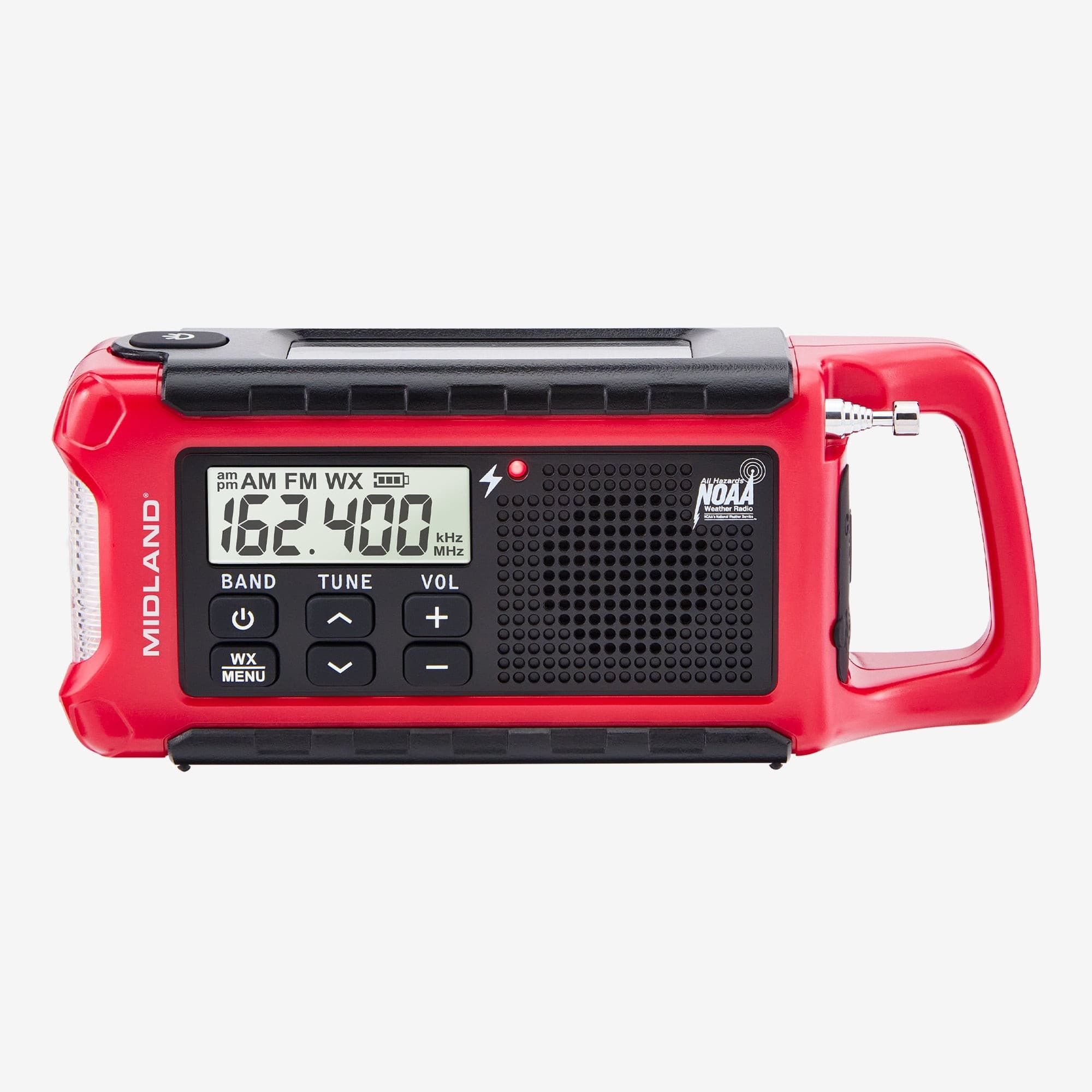
It carries the one feature that makes Midland's crank radios worth owning — automatic NOAA alert scan — into a smaller, cheaper body from the same line as our hands-on pick.
Buy From
MidlandAffiliate links · We earn a small commission at no cost to you. How this works
We evaluate every pick for real-world reliability.
How We Evaluated
How we evaluated this
We researched the ER210 through Midland's published specs, independent roundup coverage, and real owner reviews — the same homework we'd do before buying it for our own house. We don't have hands-on time with this specific unit. Unusually for our researched reviews, we own and have tested its bigger sibling, the ER310, and that first-hand context informs how we read the ER210's spec sheet.
Every figure here is attributed: features, runtime, flashlight, phone-charge rating, dimensions, and price come from Midland's ER210 product page (checked June 2026); the size-and-positioning comparison comes from HiConsumption's tested roundup; the real-world limits come from owner reviews and a hands-on writeup at ChaseDay. One number we deliberately don't print: battery capacity. Midland's product page says 2,600 mAh and a Midland user-guide figure of 2,200 mAh shows up in search — their own materials disagree, so we flag it rather than guess. Warranty term isn't on the product page either; check the box before you buy if coverage matters.
Our pick: Midland ER210 Emergency Crank Weather Radio
The verdict
Here's where this review sits, plainly: we bought and hands-on tested the Midland ER310 — read that review for our first-hand notes — and the ER210 is its smaller sibling, which we've researched but not handled. The core job carries over per Midland's spec sheet: digital AM/FM plus the NOAA weather band, with Weather Alert Scan that sounds on its own when a warning is issued for your area, three-way power (hand crank, solar, rechargeable lithium battery), a 130-lumen CREE flashlight with an SOS beacon, and up to 25 hours of normal use. HiConsumption's roundup pegs it at about a third smaller than the ER310 and calls it "a serviceable option at a slightly lower price" whose "hand crank works quickly." The honest question here isn't whether the ER210 is good — it's whether saving a little beats buying the exact unit we tested. For most households we'd still say buy the ER310. The ER210 is the right call when size decides: the glovebox, the bag, the desk drawer at work. Just go in knowing what owners flag below — the phone-charging and battery limits are real, and they're the difference between a backup radio and a power bank.
Why We Chose This
It carries the one feature that makes Midland's crank radios worth owning — automatic NOAA alert scan — into a smaller, cheaper body from the same line as our hands-on pick.
What owners report
The most consistent owner complaint isn't a defect — it's a mismatch of expectations. Midland built the ER210's onboard power bank for older, smaller-battery devices, and newer phones draw too much; because the radio protects its own charge first, several owners report it barely tops up a modern phone, and a few say it won't charge one at all. Midland says as much in their own help materials. Read it as an emergency bridge for a few calls and texts, not a power bank.
The crank and solar are the same story: top-ups, not refills, and both are slow. The hands-on writeup at ChaseDay says the crank "needs some elbow grease to make a real difference," and the solar "charges slowly if it's cloudy" — it's meant to stretch a charge, not fill one, so the advice is to charge by USB first, then set it in the sun. A few owners report the crank or solar simply not working on their unit out of the box.
Battery longevity is the weak spot for a minority. Some owners report the cell dropping to about half charge within a week, or dying soon after purchase with a hard-to-find replacement. It's fair to call this recurring but not the norm — ChaseDay and plenty of owners say the battery "lasts a surprisingly long time." One more note from the same hands-on review: the plastic housing "feels like it might not survive a big drop" and "could crack if you drop it on concrete," so it's a glovebox radio, not a tossed-in-the-truck-bed one.
Other options to consider
Midland ER310
The version of this radio we actually bought and tested — bigger battery, an AA-battery fallback the ER210 drops, and our first-hand experience behind it. Unless size rules it out, it's the better buy.
Read full review →RunningSnail MD-090P
The budget option. Independent testing scored its NOAA reception surprisingly well, but the build is a clear step down. A fine backup, not the household's only radio.
Technical Specifications
| Radio + Alerts | Digital AM/FM + NOAA Weather Band, automatic Weather Alert Scan (Midland) |
| Power / Runtime | Hand crank / solar / rechargeable Li-ion; up to 25 hrs normal use (Midland) |
| Size | 6.5" × 2.8" × 1.9" — ~33% smaller than the ER310 (HiConsumption) |
Sources we consulted
We may earn a commission when you buy through links on this page. How this works
Preparedness Gear
Midland ER210 Emergency Crank Weather Radio
Evaluated for household use · Affiliate links disclosed
The smaller sibling of our tested pick
Why we chose it
It carries the one feature that makes Midland's crank radios worth owning — automatic NOAA alert scan — into a smaller, cheaper body from the same line as our hands-on pick.
Buy From
MidlandAffiliate links · We earn a small commission at no cost to you. How this works
We evaluate every pick for real-world reliability.