Who this is for
Every household — a NOAA radio is non-negotiable emergency gear.
Skip if
Anyone that already owns a dedicated NOAA radio with alarm mode.
Preparedness Gear
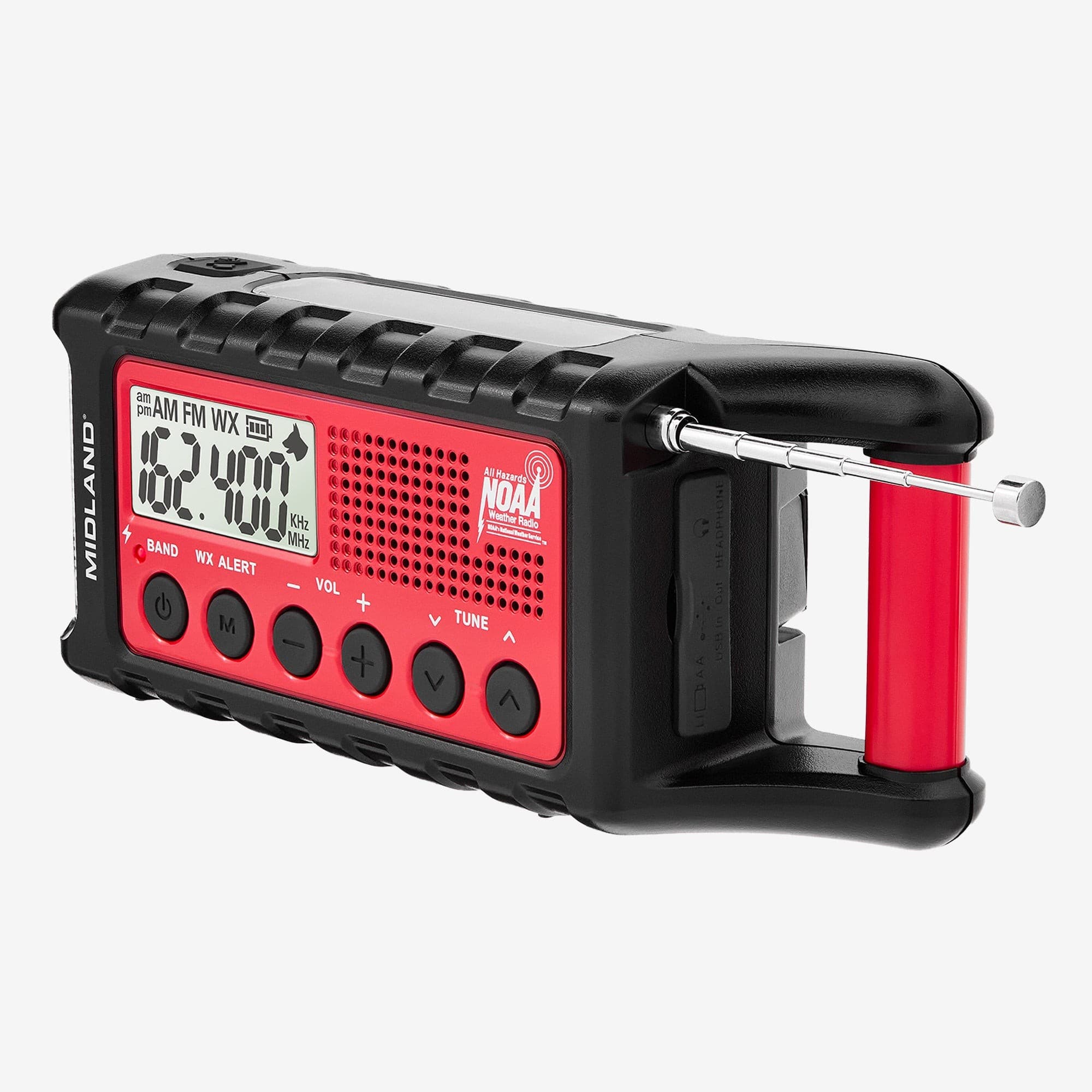
Midland ER310 Emergency Crank Radio
Evaluated for household use · Affiliate links disclosed
NOAA weather alerts, hand crank, solar, and USB phone charging in one unit
Why we chose it
Its NOAA alert mode wakes you automatically during warnings, and three power sources mean it works when everything else has failed.
Buy From
MidlandAffiliate links · We earn a small commission at no cost to you. How this works
We evaluate every pick for real-world reliability.
Why this matters
Why this matters in an emergency
When the power's out and the cell network is jammed, the scariest part isn't the dark — it's not knowing. Is the storm getting worse? Is there an evacuation order? Has the boil advisory lifted? A weather radio answers that when nothing else can, because it pulls a signal straight from the National Weather Service that doesn't care whether the grid or the cell towers are up.
The Midland ER310 does that, and then keeps going: it'll charge your phone off a hand crank when your battery's at 2%, throw a flashlight beam down a dark hallway, and wake you with an alarm if a warning hits your county at 3am. For a household, it's the one device that covers the jobs you can't predict — information, light, and a last-ditch phone charge — without depending on anything you might not have. It sits in a drawer doing nothing for years, and then it's the most useful thing in the house for two days.
How We Evaluated
How we evaluated this
We bought this one and put hands on it — cranked it, charged off it, tuned the channels, the works. We spun the hand crank to see how much radio time a minute of cranking actually buys (less than the box implies; more on that below), tuned in the NOAA weather channels and triggered the alert mode to hear what wakes you up, and set it in a sunny window to watch the solar trickle do its slow thing. We plugged a phone into the USB port to confirm it really does charge, and clicked through the flashlight and the red SOS beacon.
Then we backed that up with the usual homework. We read through a stack of owner reports focused on the two things a few hours of handling can't tell you: how the internal battery holds up after a couple of years, and how the AM/FM reception does out in rural areas far from a transmitter. We cross-referenced Midland's specs — the seven NOAA channels, the charging outputs — against what owners actually report living with. What we didn't do is run a multi-year battery-degradation test ourselves; for that we leaned on long-term reviews. Everything we say about using it day-to-day, though, comes from actually using it.
Our pick: Midland ER310 Emergency Crank Radio
The verdict
A do-everything emergency radio: NOAA alerts that wake you during warnings, three ways to power it, and a USB output to keep your phone alive. For most households, it covers the core outage jobs in a single unit.
- NOAA alert mode wakes you automatically
- Three power sources — works when everything fails
- Phone charging keeps your most critical device alive
- Crank charges slowly — 1 min crank = ~10 min radio
- AM/FM reception mediocre in rural areas
What it does well
The ER310 is built around the one feature that matters most in a weather emergency: NOAA alert mode. You tune it to your local weather channel, switch the alarm on, and it sits silent until the National Weather Service pushes a warning for your area — then it wakes you. That's the difference between sleeping through a midnight evacuation order and getting a head start, and it works with no cell signal and no internet at all.
The rest is about not running out of power. It takes a charge three ways — a hand crank, a solar panel on top, and a tray of AA batteries — so it's genuinely hard to end up with a dead radio. The big internal battery means a charged unit runs a long stretch on its own, and the USB output lets it push some of that charge into your phone, which in a long outage can feel like a small miracle. The LED flashlight is bright, there's a softer area lamp, and a red SOS beacon for flagging help. The build feels sturdy and the controls are simple enough to work in the dark.
What it does poorly
The hand crank is real, but manage your expectations: cranking is a trickle, not a fountain. A solid minute of cranking buys only several minutes of radio, and topping up a phone by crank alone is a serious arm workout — it's an emergency backstop, not a charging plan. The AM/FM reception is fine in town but gets weak and hissy out in rural areas far from a transmitter, where you might want it most. The solar panel is small, so it's a slow top-up over a sunny day, not a fast charger. And as with any device with a built-in rechargeable battery, that battery is the part most likely to weaken over the years.
Where it shines
Riding out a storm or a multi-day outage at home. It's the device that tells you what's happening, keeps a flashlight and your phone alive, and wakes you if the situation changes overnight — all without a working grid or network.
Where it frustrates
Leaning on the crank as a primary power source. If you expect to crank your phone to full, you'll be disappointed and tired. And if you're rural, the AM/FM static may push you to rely on the NOAA channels — which come in clearly — over regular broadcast stations, which may not.
Other options to consider
Midland ER210
The ER310's smaller sibling — most of the same DNA for less. Its USB phone charging is weaker (a top-up, not a full refill) and it runs a smaller battery, so the ER310 does more in a real outage. If a strong phone charge isn't your priority it's a fine cheaper pick, but for most households the ER310's extra capacity is worth it.
Read full review →RunningSnail MD-090P
A popular budget crank radio — AM/FM plus NOAA weather channels with alerts, hand-crank/solar/USB charging, a flashlight, and a built-in power bank. A handy throw-in-the-car or go-bag backup. The build and controls are more basic than pricier weather radios, so it earns its place as a spare or second radio rather than your only one.
Read full review →
You might also like
Longevity
How long will this actually last
The thing to watch on any crank radio is the built-in rechargeable battery, and the ER310 is no exception — it's the part most likely to weaken over the years, especially if the radio sits fully drained for long stretches. The good news is the ER310 hedges against that better than most: even if the internal battery fades, you can drop in AA batteries, crank it, or solar-charge it, so the radio keeps working long after a sealed-battery unit would be dead weight.
To get the most life out of the internal pack, top it off every few months while it's in storage rather than letting it sit empty, and keep it out of a hot car, since heat ages batteries fastest. The crank mechanism and the solar panel are simple and tend to outlast the battery. There's nothing to service and nothing to replace on a schedule — just keep a few spare AAs taped to it so a tired internal battery never leaves you without a radio. Treated that way, it's a buy-it-once device that should be ready whenever you reach for it.
Questions people actually ask
How long does cranking actually power the radio?
Can I charge my phone with it?
What happens if it gets wet?
Is it worth it if I only lose power once or twice a year?
Does the NOAA alert wake you up automatically?
Technical Specifications
| Flashlight | true |
| Sos Beacon | true |
| Usb Charging | true |
| Noaa Channels | 7 |
| Power Sources | Hand crank,Solar,6 AA batteries |
We may earn a commission when you buy through links on this page. How this works
Preparedness Gear
Midland ER310 Emergency Crank Radio
Evaluated for household use · Affiliate links disclosed
NOAA weather alerts, hand crank, solar, and USB phone charging in one unit
Why we chose it
Its NOAA alert mode wakes you automatically during warnings, and three power sources mean it works when everything else has failed.
Buy From
MidlandAffiliate links · We earn a small commission at no cost to you. How this works
We evaluate every pick for real-world reliability.