Who this is for
Households that want a way to keep a room warm during a winter power outage without the grid — and who will follow the ventilation, no-sleeping, no-cooking, and CO-alarm rules every time.
Skip if
Skip it if you can't or won't run it with ventilation and a battery CO alarm — indoors, that's not optional with any fuel-burning heater. Skip it if you're in Massachusetts or Canada (indoor use is restricted) or a California dwelling. And it's a room heater, not a whole-house solution — it won't heat a large or multi-room home.
Preparedness Gear
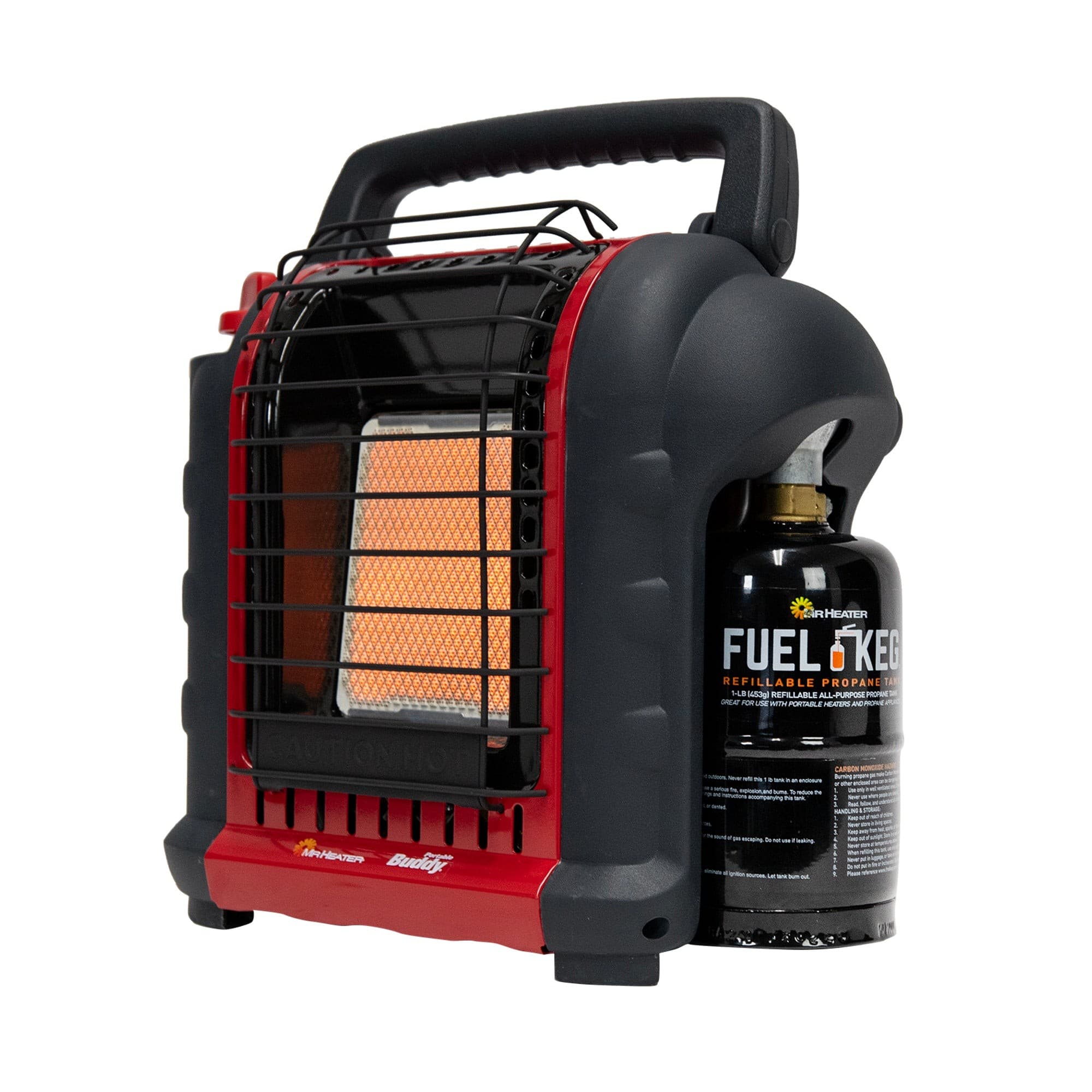
Mr. Heater Portable Buddy Propane Heater (MH9BX)
Evaluated for household use · Affiliate links disclosed
9,000 BTU of grid-free heat, indoor-rated with an oxygen-depletion shutoff. Only safe with ventilation and a battery CO alarm — never while sleeping.
Why we chose it
The standard grid-free room heater: 9,000 BTU off a 1-pound propane cylinder, indoor-rated with an oxygen-depletion and tip-over shutoff. The right tool for a cold outage — used strictly by its safety rules, with a battery CO alarm.
Buy From
Mr. HeaterAffiliate links · We earn a small commission at no cost to you. How this works
We evaluate every pick for real-world reliability.
Why this matters
Why this matters in an emergency
When the power fails in winter, a house can get dangerously cold within hours — and unlike a lantern or a phone charger, keeping warm without the grid is genuinely hard to improvise safely. Space heaters need electricity. A fireplace needs a chimney. That's why a propane radiant heater fills a real gap: it puts out serious heat from a small cylinder, no wiring required.
But it's also the highest-stakes piece of outage gear a household can own, because burning any fuel indoors produces carbon monoxide — an odorless gas that has killed people during winter outages. The whole point of an indoor-rated heater like this one is that it's built to be used inside safely — if, and only if, you follow the rules. This review is as much about those rules as the heater itself, because with this category, how you use it matters more than which model you buy.
How We Evaluated
How we evaluated this
We researched the Portable Buddy the way we'd shop for our own house — Mr. Heater's published specs plus U.S. Consumer Product Safety Commission (CPSC) guidance on this class of heater — and we'll say plainly we haven't run this unit ourselves. The core specs (4,000-9,000 BTU, 225 square feet, oxygen-depletion sensor, tip-over shutoff, 1-pound cylinder) come from Mr. Heater's product page. For the safety claims we leaned on CPSC directly rather than general web coverage, because this category gets a lot of it wrong.
One correction we'll make up front: the oxygen-depletion sensor is a real, CPSC-recognized safety feature — it's specifically why heaters like this are permitted indoors when older heaters must never be — but it is not a carbon-monoxide detector, and we don't treat it as one. Where we couldn't verify an exact figure — the precise ventilation minimum, or the exact certification marking on the unit — we say so and point you to the manual, rather than inventing a number.
Our pick: Mr. Heater Portable Buddy Propane Heater (MH9BX)
The verdict
The Portable Buddy is the heater most households reach for when the power's out and it's cold: 4,000 to 9,000 BTU, enough for a room up to about 225 square feet, running off a 1-pound propane cylinder — no grid needed. It's genuinely indoor-rated, and that rating rests on a real safety feature: an oxygen-depletion sensor (ODS) that shuts the heater off if the room's oxygen drops too low. But "indoor-safe" is not unconditional — this is a combustion appliance burning fuel inside your home. Three rules are non-negotiable: keep a window cracked for ventilation (consult the included manual for the exact specifications), never run it while you sleep, and never cook with it. And because the ODS is not a carbon-monoxide detector, you must run a battery-powered CO alarm in the room with it. Used that way, it's a sensible, grid-free way to keep a room warm. Ignore those rules and a propane heater indoors can kill — we cover a real case below. We researched this from Mr. Heater's specs and CPSC safety guidance; we haven't tested it ourselves. Note: it's restricted from indoor use in Massachusetts and Canada.
- Real grid-free heat — up to 9,000 BTU / ~225 sq ft off a 1-lb propane cylinder
- Indoor-rated, with an oxygen-depletion sensor and tip-over shutoff
- Radiant heat warms quickly; light at 10.6 lb
- Explicitly excluded from the 2004 Big Buddy valve-leak recall (CPSC)
- Restricted from indoor use in Massachusetts and Canada (and limited in California dwellings)
- Tip-over shutoff is sensitive — cuts off if bumped (restarts quickly)
What it does well. For grid-free heat, the Portable Buddy hits the sweet spot: 9,000 BTU on high is enough to take the edge off a room up to about 225 square feet, and it runs off a cheap, storable 1-pound propane cylinder (or a 20-pound tank with an optional hose). It's radiant, so it warms people and objects in front of it quickly. At 10.6 pounds it's easy to move where you need it. Its safety hardware is real: an oxygen-depletion sensor and an accidental tip-over shutoff, both standard.
The safety rules — non-negotiable, not tips. This is a combustion appliance, and using it indoors is only safe under conditions:
- Ventilation: it consumes the room's oxygen and must have fresh combustion and ventilation air — crack a window. Consult the included manual for the exact ventilation specifications for your space.
- Never while sleeping: you can't smell carbon monoxide, and you won't wake up. Turn it off before bed.
- Never cook with it: it's a heater, not a stove; cooking on it is an explicitly prohibited use.
- Run a battery CO alarm: the oxygen sensor is not a CO detector. A battery-powered carbon-monoxide alarm in the same room is a hard requirement, not an accessory — many retailers sell the heater bundled with one.
- Know the restrictions: it's restricted from indoor use in Massachusetts and Canada (and reportedly limited in California dwellings) — the "indoor-safe" label has legal carve-outs.
How the oxygen sensor actually works (and doesn't). CPSC explains that the ODS senses when a room's oxygen falls below about 18 percent and shuts the gas off before the heater can produce dangerous levels of CO. That's a genuine safeguard — it's why this class of heater is allowed indoors at all. What it does not do is measure carbon monoxide, and it is not a substitute for ventilation or a CO alarm. Treat it as a backstop, not a green light.
Where it frustrates. The tip-over shutoff is sensitive — owners report it cutting off if the heater gets bumped or jostled; it restarts quickly once you set it upright, and that's the safety feature doing its job. The single 1-pound cylinders mean you'll want spares on hand for a long outage.
What owners report
The safety record, honestly. First, precisely scoped: the 2004 valve-leak recall that people sometimes bring up covered the larger Big Buddy and Tough Buddy (model MH18B), and CPSC's own notice states it "does not apply to Mr. Heater Portable Buddy, MH9B" — this heater was explicitly excluded. We found no recall and no verified case of carbon-monoxide poisoning tied to a correctly-used, ventilated Portable Buddy with a working oxygen sensor.
A real case — why the rules are non-negotiable. Reports of carbon-monoxide deaths involving these heaters do exist, and they share a pattern: misuse. In December 2019, according to RVTravel, a man named David Dana died of carbon-monoxide poisoning in his van in Kennewick, Washington, using what reports describe as a Mr. Heater propane appliance. The details are the lesson: he was reportedly using it to cook food inside the vehicle — an explicitly prohibited use — in a van that had added insulation and was unusually sealed, and at least one report says the heater was not in its standard indoor-rated configuration and had its safety systems bypassed. The exact model is not cleanly confirmed as this one across sources, and we're not going to claim it was; the manufacturer (Enerco) commented and investigated. We include it not to say this heater killed someone — that would overstate it — but because it is a real, documented illustration of exactly what the ventilation, no-cooking, no-sleeping, and CO-alarm rules above are there to prevent. Follow them and none of it applies to you.
The everyday quirk. The tip-over shutoff is over-sensitive — owners commonly report it clicking off when the heater is jostled. That's the safety feature working; set it upright and the ignition restarts in seconds.
Other options to consider
Mr. Heater Little Buddy
The smaller sibling — about 3,800 BTU for a smaller space (~95 sq ft), same 1-lb cylinder. Confirm it has the tip-over shutoff before choosing it over the Portable Buddy.
A battery-powered CO alarm (required companion)
Not an alternative — a required companion. Any fuel-burning heater used indoors needs a battery-powered carbon-monoxide alarm in the room. Buy it with the heater.
Read full review →
Longevity
How long will this actually last
A propane radiant heater like this has no electronics to fail and no bulb to burn out; kept clean and dry, it lasts for years of occasional outage use. The consumables are the propane cylinders — keep several 1-pound cylinders stored (they don't expire in any practical sense) or a 20-pound tank with the optional hose for a long cold stretch.
The one part worth checking periodically is the oxygen-depletion sensor pilot assembly, which is a replaceable service part; if the heater starts shutting off for no clear reason in a well-ventilated room, that's the part to look at. Store it away from moisture, and at the start of each cold season confirm the tip-over and oxygen shutoffs still work — the whole reason to own this is that it works, safely, the one time you need it.
Questions people actually ask
Is it really safe to use indoors?
Does the oxygen sensor detect carbon monoxide?
Do I really need a separate carbon-monoxide detector?
Was this heater recalled?
How much ventilation do I need?
Technical Specifications
| Output | 4,000 / 9,000 BTU per hour |
| Coverage | up to 225 sq ft |
| Fuel | 1 lb propane cylinder (or 20 lb tank via optional hose) |
| Safety Shutoffs | Oxygen-depletion sensor (shuts off if room O2 drops below ~18%, per CPSC) + accidental tip-over shutoff |
| CO Detector | NOT included and NOT a substitute - run a battery-powered CO alarm (required) |
| Ventilation | Required - consult the included manual for the exact specifications |
| Certification | Indoor-rated; CSA 4.98 is the standard CPSC names (verify the marking on the unit) |
| Restrictions | No indoor use in Massachusetts or Canada; limited in California dwellings |
| Weight | 10.6 lb |
Sources we consulted
We may earn a commission when you buy through links on this page. How this works
Preparedness Gear
Mr. Heater Portable Buddy Propane Heater (MH9BX)
Evaluated for household use · Affiliate links disclosed
9,000 BTU of grid-free heat, indoor-rated with an oxygen-depletion shutoff. Only safe with ventilation and a battery CO alarm — never while sleeping.
Why we chose it
The standard grid-free room heater: 9,000 BTU off a 1-pound propane cylinder, indoor-rated with an oxygen-depletion and tip-over shutoff. The right tool for a cold outage — used strictly by its safety rules, with a battery CO alarm.
Buy From
Mr. HeaterAffiliate links · We earn a small commission at no cost to you. How this works
We evaluate every pick for real-world reliability.