Skip if
Multi-day outages or high-draw appliances. 768Wh is an evening of essentials, not a weekend of them, and the 1,200W ceiling rules out space heaters, kettles, and anything with "1500W" on the label.
Preparedness Gear
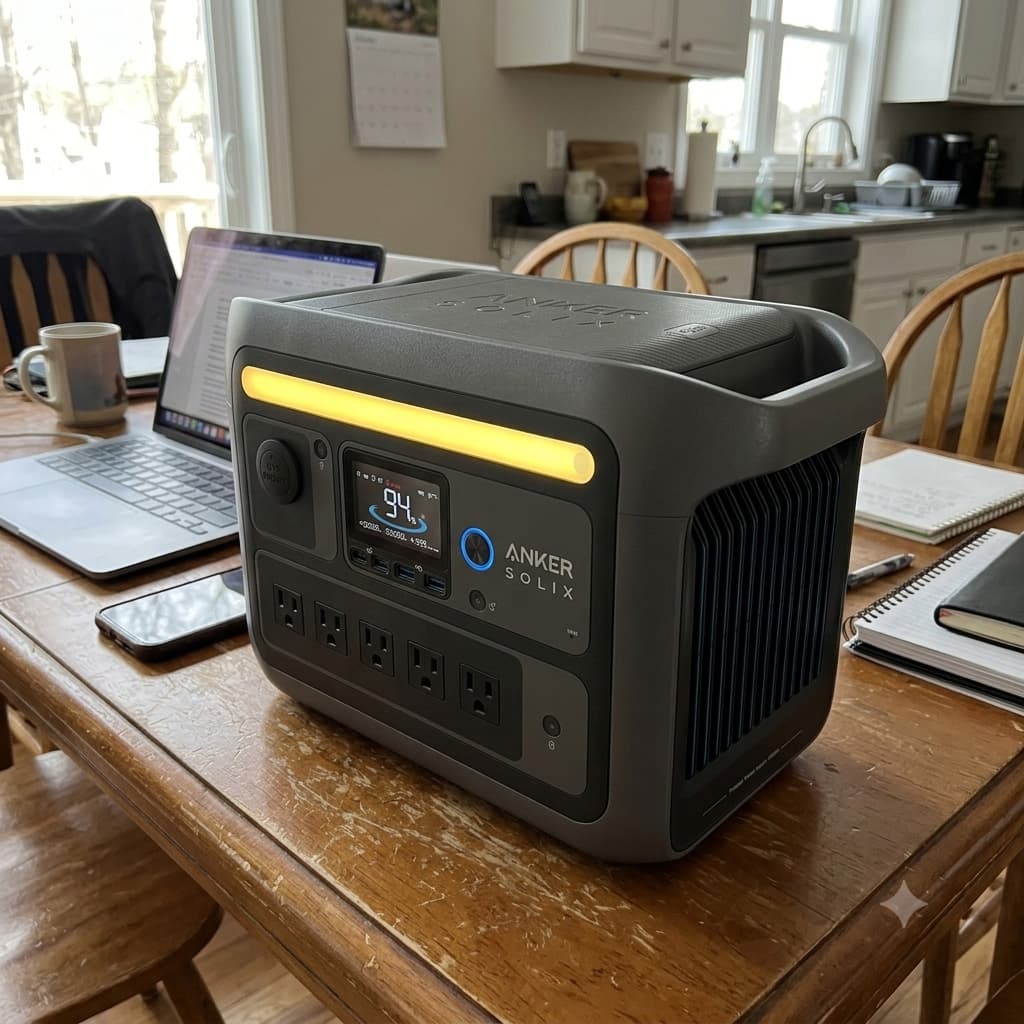
Anker SOLIX C800 Portable Power Station
Evaluated for household use · Affiliate links disclosed
A reliable option for shorter outages
Why we chose it
It brings Anker's LFP chemistry, fast recharge, and 5-year warranty down to a size and price more households can justify for a first power station.
Buy From
AnkerAffiliate links · We earn a small commission at no cost to you. How this works
We evaluate every pick for real-world reliability.
How We Evaluated
How we evaluated this
We researched the SOLIX C800 through Anker's manufacturer specs, independent testing, and what owners report — the same homework we'd do before buying one for our own house. We don't have hands-on time with this unit yet, so nothing here is a measurement we took. Every figure is attributed: capacity, output, ports, charging, and warranty come from Anker's official C800 page; the tested charge times, the 10–20ms UPS switchover, the measured fan-noise readings, and the no-charge-below-freezing note come from Backup Power Hub's review. Where Anker's sheet and the test bench disagree — the charge-time framing, the AC-outlet count, the weight — we say so rather than pick a winner.
Our pick: Anker SOLIX C800 Portable Power Station
The verdict
The standard SOLIX C800 (the A1753 — not the C800 Plus with the camping lights, and not the newer C800X) is the right-sized answer for households that don't need a kilowatt. You get 768Wh of LFP capacity rated for 3,000 cycles, 1,200W of output with a 1,600W surge, ten ports by Anker's count, and a 5-year warranty — the same battery story as units twice the price. It recharges fast: Anker rates a full charge in about an hour, and Backup Power Hub's independent timing reached 80% in 58 minutes and full in roughly 1.5 hours. It also does the UPS trick, taking over for a router in a measured 10–20 milliseconds. The catches are honest ones: the fan ramps up under load, the power-saving mode can drop small trickle loads if you don't set it first, and it won't charge below freezing. For an evening outage's essentials at the right price, it's an easy unit to recommend.
Why We Chose This
It brings Anker's LFP chemistry, fast recharge, and 5-year warranty down to a size and price more households can justify for a first power station.
What owners report
The most consistent note from testers is the fan. Backup Power Hub measured it at 35 dB at idle (under 400W), 42 dB at medium load (400–800W), and 47 dB under heavy load (800–1,200W) — audible under sustained high draw, not harsh. Reviewers of the camping-light sibling noted it gets more present above roughly 950W of fast charging in a warm room; it's the same charging engine, so expect some fan when you push it.
The gotcha worth setting up before your first outage: the power-saving logic can drop low-draw devices. Anker's own support docs note the AC outlets switch off after about 15 minutes with no plug detected, a 12-hour standby power-off when no load is sensed, and USB ports that can cut out on a very small draw — reactivated by unplugging and replugging. You set the standby behavior in the app. None of this is a defect, but a trickle load like a phone on USB can quietly stop charging if you haven't adjusted it. Set it up at home, not on your first night.
Two more limits owners should plan around: Backup Power Hub notes the unit won't accept a charge below 32°F (a normal LFP protection against lithium plating), so a freezing garage or winter vehicle is a poor place to top it off; and there's no IP weather rating — the protective bag is sold separately, so keep it dry. Genuine multi-year failure reports are still sparse as of mid-2026 — it's a relatively new unit — so we can't point to a durable problem pattern, and we won't pretend the absence proves anything either way.
Other options to consider
Bluetti AC180
Our reviewed category pick, a half-step up in capacity with its own UPS mode. The AC180 carries a longer evening; the C800 answers with less weight and usually less money. Price often settles it.
Read full review →EcoFlow Delta 2
One full class up. Choose it over the C800 when a fridge through the night is on your list, or when expansion batteries are in your future.
Read full review →Anker SOLIX C1000
Same brand and battery story, the next size up at about 1,056Wh and six AC outlets. The natural step up if 768Wh feels tight but you like Anker's fast-charge approach.
Read full review →Jackery Explorer 1000 v2
Also a class up in capacity, and notably light for it. If you're torn between evening essentials and overnight essentials, it's a light way to buy the bigger answer.
Read full review →
Technical Specifications
| Capacity | 768Wh, LFP (Anker) |
| AC Output | 1,200W continuous / 1,600W surge (Anker) |
| Wall Recharge | ~58 min to 80%, ~1.5 hr full (Backup Power Hub tested; Anker rates full in ~1 hr) |
Sources we consulted
We may earn a commission when you buy through links on this page. How this works
Preparedness Gear
Anker SOLIX C800 Portable Power Station
Evaluated for household use · Affiliate links disclosed
A reliable option for shorter outages
Why we chose it
It brings Anker's LFP chemistry, fast recharge, and 5-year warranty down to a size and price more households can justify for a first power station.
Buy From
AnkerAffiliate links · We earn a small commission at no cost to you. How this works
We evaluate every pick for real-world reliability.