Skip if
Anyone that expects their backup needs to grow — there's no expansion battery, so a second unit is the only way up — or anyone counting on older Jackery solar panels, which need an adapter to charge it.
Preparedness Gear
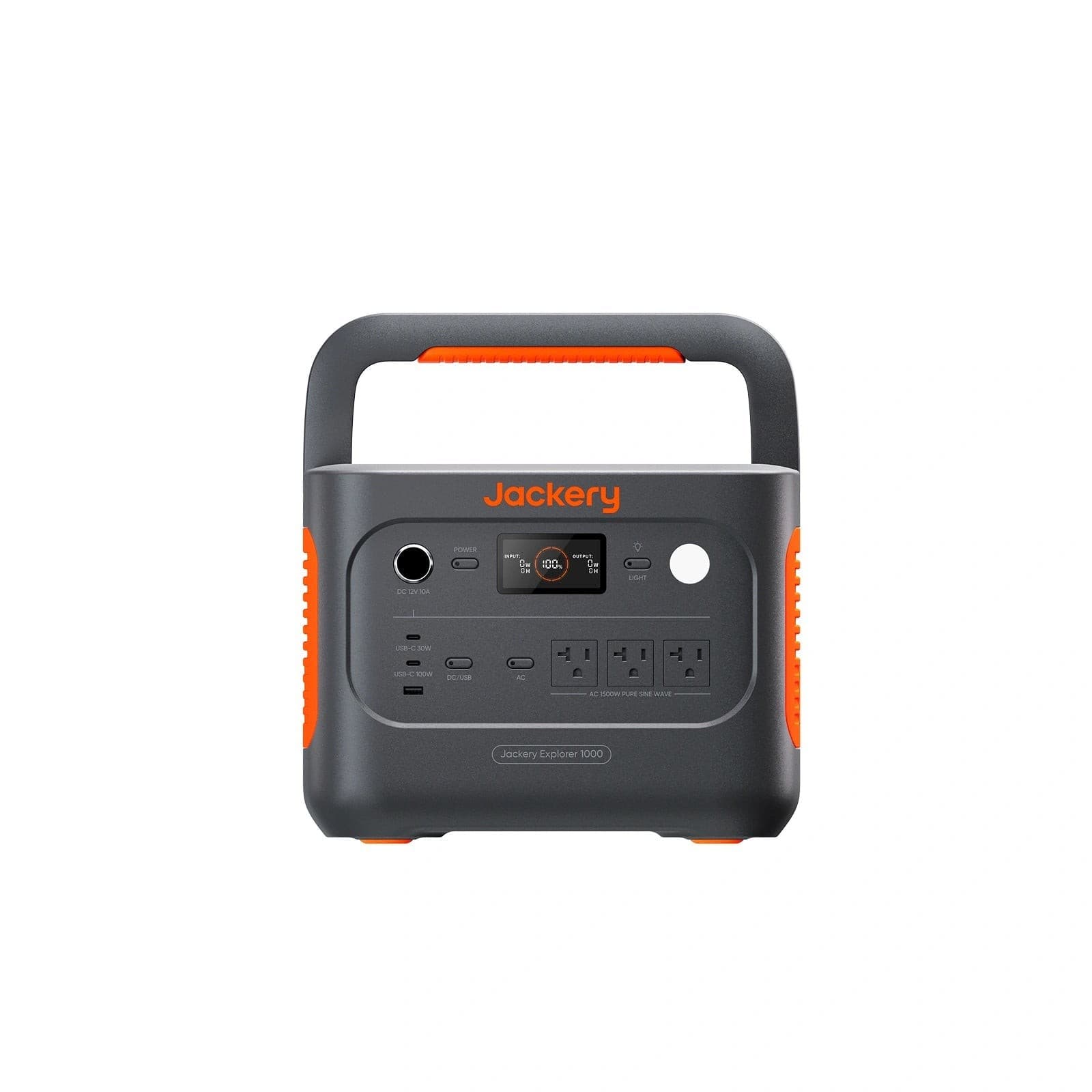
Jackery Explorer 1000 v2 Portable Power Station
Evaluated for household use · Affiliate links disclosed
The lighter pick when weight wins over expandability
Why we chose it
It's one of the lighter units in its class — 23.8 pounds for 1,070Wh, per Jackery — with LFP cells Jackery rates for 4,000 cycles and an app emergency mode that independent testers timed refilling it in just under an hour.
Buy From
JackeryAffiliate links · We earn a small commission at no cost to you. How this works
We evaluate every pick for real-world reliability.
How We Evaluated
How we evaluated this
We researched the Explorer 1000 v2 the same way we'd shop for one ourselves — manufacturer specs, independent load testing, and real owner reports. We haven't had this unit on our own bench, so nothing here is a measurement we took. Every figure is attributed to where it came from: capacity, output, weight, and cycle-life come from Jackery's published specs; the tested efficiency, surge behavior, and stopwatch recharge times come from The Solar Lab's independent load test, with a five-month field log from Outdoor Tech Lab and an owner-report roundup from RV Outfitting. Where the marketing and the test bench disagree — the surge rating is the clearest case — we say so.
Our pick: Jackery Explorer 1000 v2 Portable Power Station
The verdict
The Explorer 1000 v2 fixes the original Explorer's biggest knock: chemistry. This one runs LiFePO4 cells that Jackery rates at 4,000 charge cycles to 70%+ capacity — the long-life kind you want in gear that mostly sits and waits. At 23.8 pounds (Jackery) it's a genuine one-hand carry, and The Solar Lab measured a solid 87.5% inverter efficiency under a near-maximum load. The honest catches: capacity is fixed (no expansion battery), and in The Solar Lab's testing the 3,000W surge rating held only about 2,200W for a couple of seconds before the unit shut itself off to stay safe. See What owners report below for the connector and app quirks that come up most. For one-room essentials through an overnight outage, it's an easy unit to live with.
Why We Chose This
It's one of the lighter units in its class — 23.8 pounds for 1,070Wh, per Jackery — with LFP cells Jackery rates for 4,000 cycles and an app emergency mode that independent testers timed refilling it in just under an hour.
What owners report
Across owner roundups and a five-month field log, the v2 reads as a dependable unit with a few specific friction points — none of them dealbreakers, but worth knowing before you buy.
- Solar-connector compatibility is the most common gripe. The v2 uses a newer 8mm (DC8020) solar/car input, while older Jackery panels and many generic 12V cables use the older 7.9mm (DC7909) plug — they fit loosely and won't charge reliably without an adapter. RV Outfitting and Outdoor Tech Lab both call this the unit's most legitimate long-term frustration. (The Solar Lab described the connectors differently, as "older MC3-style" — either way, check your panel's plug before assuming it works.)
- App and Bluetooth drops come up regularly. Several owners report Bluetooth disconnecting and Wi-Fi occasionally refusing to reconnect, sometimes needing a reset — which matters because the fast "emergency" charge lives behind the app.
- Emergency mode resets every session. The five-month field log notes the fast-charge mode defaults back to the slower 1.7-hour rate after each charge, so you re-enable it in the app (about four taps) each time you want the one-hour fill.
- Small AC loads stretch less than the 1,070Wh on the label suggests. Owners who assume the full rating is usable AC energy are commonly surprised; the inverter's overhead makes low-watt AC loads relatively inefficient — consistent with the measured 87.5% figure.
- Cold slows the fast charge. Near freezing, the battery-protection logic cut the charge rate, so the tester's "emergency" charges ran about 72–74 minutes instead of 61–63.
- Serious failures are the uncommon tail. A small subset of owners report error states, charging oddities, or units needing replacement after a few months. It's real but not the typical experience — the large majority of field reports describe trouble-free use.
Other options to consider
EcoFlow Delta 2
Our overall power pick, and the unit we'd steer most households to first. It's the heavier carry, but it takes expansion batteries the Jackery can't — read our full review. Choose the Jackery when carrying weight matters more than growing capacity.
Read full review →Anker SOLIX C1000
A faster-recharging rival in the same class — Anker rates it under an hour to full, with six AC outlets to the Jackery's three. The trade is several extra pounds and a fan independent testers found loud at full tilt.
Read full review →Bluetti AC180
Another LFP unit in the class, with a fast UPS switchover as its standout. Like the Jackery, its capacity is fixed — so the choice often comes down to weight versus whichever is on sale.
Read full review →
Technical Specifications
| Capacity | 1,070Wh (Jackery) |
| Weight | 23.8 lb / 10.8 kg (Jackery) |
| Surge | 3,000W rated; held ~2,200W briefly before shutoff in independent testing (The Solar Lab) |
Sources we consulted
We may earn a commission when you buy through links on this page. How this works
Preparedness Gear
Jackery Explorer 1000 v2 Portable Power Station
Evaluated for household use · Affiliate links disclosed
The lighter pick when weight wins over expandability
Why we chose it
It's one of the lighter units in its class — 23.8 pounds for 1,070Wh, per Jackery — with LFP cells Jackery rates for 4,000 cycles and an app emergency mode that independent testers timed refilling it in just under an hour.
Buy From
JackeryAffiliate links · We earn a small commission at no cost to you. How this works
We evaluate every pick for real-world reliability.