Who this is for
Budget-conscious buyers, emergency kit baseline builders, and light-duty emergency power routing.
Skip if
Expandable high-capacity needs or multi-day whole-house support.
Preparedness Gear
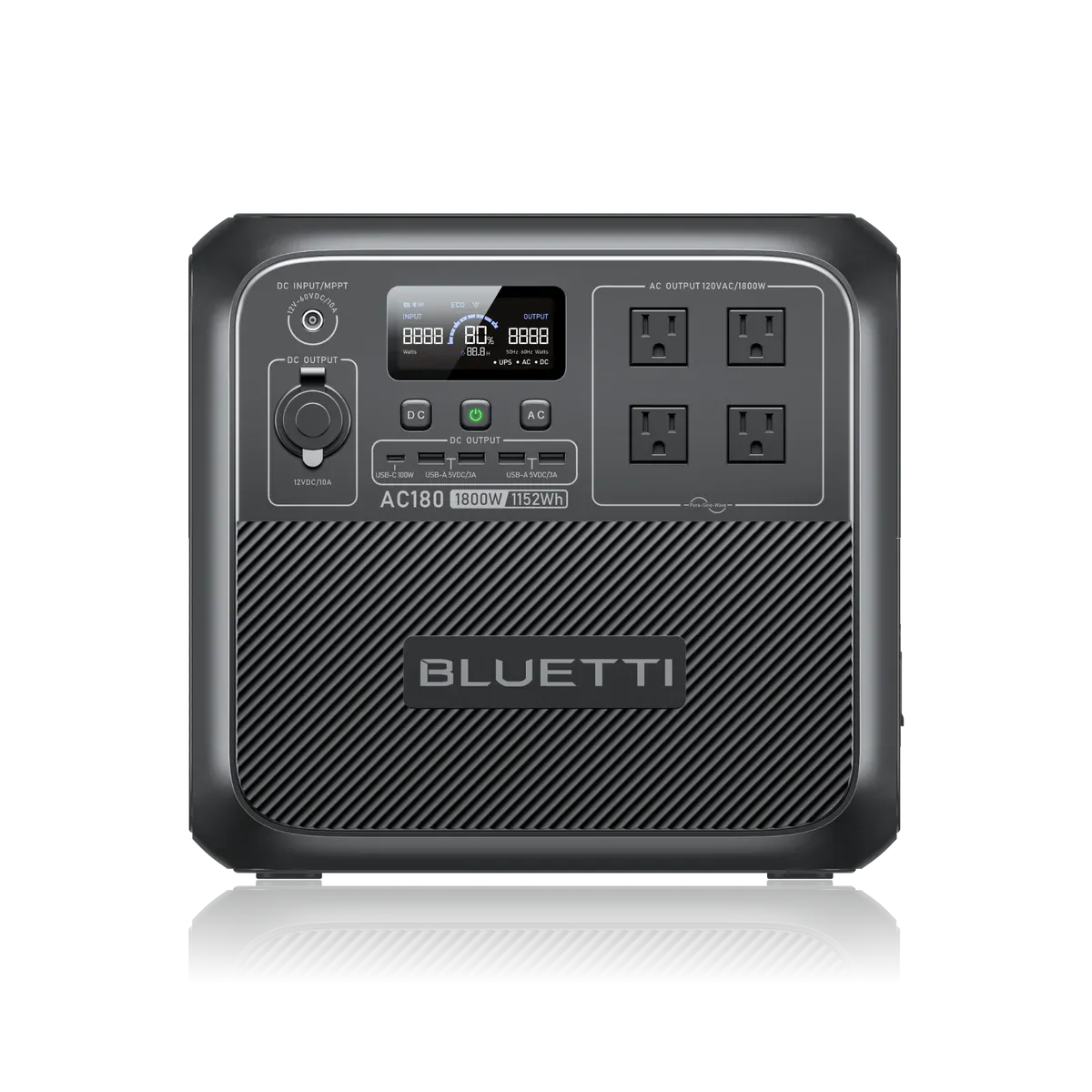
BLUETTI AC180 Portable Power Station
Evaluated for household use · Affiliate links disclosed
A solid value pick for budget-conscious households
Why we chose it
A safe LFP battery with a genuine 1,800-watt output and a standby battery-backup (UPS) mode for noticeably less than the premium units — enough to cover a household's essentials, with the UPS riding through brief grid flickers without rebooting.
Buy From
BLUETTIAffiliate links · We earn a small commission at no cost to you. How this works
We evaluate every pick for real-world reliability.
Why this matters
Why this matters in an emergency
The power goes out, and within a few hours the food in your fridge starts its slow slide toward unsafe. Phones drain, the router's dark, and if anyone in the house leans on a plug-in medical device, the clock gets louder. A power station like the AC180 turns that from a crisis into an inconvenience. It won't run your furnace or central AC — nothing this size will — but it'll keep the fridge cold, the phones and a laptop charged, the lights on, and a CPAP running through the night, all safely indoors, with no fumes.
The AC180's particular pitch is value. It gives you the big, safe LFP battery and a genuine 1,800-watt output for noticeably less than the premium units, plus a standby battery-backup mode that keeps your computer and internet running through a brief outage or flicker. For a household that wants real backup without spending premium money, it's the sensible middle of the road — enough to cover the essentials, not so much that you're paying for capacity you'll never use.
How We Evaluated
How we evaluated this
We researched the AC180 the way we'd size up a backup unit for our own house: we took BLUETTI's published specs — the 1,152-watt-hour capacity, the 1,800-watt output, the LFP battery, the under-20-millisecond UPS switchover — and checked them against independent bench testing from reviewers who measure these units under real loads. OutdoorGearLab and StorageReview each measured the usable capacity under a known load and timed the recharge, which is how we know the real-world numbers land a bit below the spec sheet.
The AC180 is a real purchase, so we're clear about sourcing: we don't have hands-on time with this exact unit yet, and the figures here come from BLUETTI and from the independent testers named in our sources, with any disagreements flagged rather than smoothed over. When we get one on our own bench, we'll add what we measure.
Our pick: BLUETTI AC180 Portable Power Station
The verdict
The BLUETTI AC180 is a value-first power station: a safe LFP battery, a genuine 1,800-watt output, a five-year warranty, and a standby battery-backup (UPS) mode, for noticeably less than the premium competition. The main trade-off is that its 1,152 watt-hours are fixed — it doesn't expand — so size it to your needs up front; if you want more headroom, Bluetti's AC180P steps up to 1,440 watt-hours. For a household that wants real, set-and-forget backup for the essentials without paying for capacity it won't use, the AC180 is an easy call.
What it does well
The AC180's headline is value. You get a 1,152-watt-hour battery and a full 1,800 watts of continuous output — enough to start and run a full-size refrigerator, the job most people buy a power station for — usually for less than the big-name premium units. The battery is lithium iron phosphate (LFP), the safe, long-lived chemistry that gives off no carbon monoxide, so it runs in a closet or bedroom without worry. That makes it a real option for apartments, where a gas generator isn't allowed. Bluetti rates it at about 45 decibels in its silent charging mode — a specific low-power setting; there's no independent sound measurement, and it runs louder under heavy load or fast charging.
It also has a Power Lifting mode — a setting that runs high-wattage resistive gear like a kettle or space heater, up to 2,700 watts, by easing the voltage down. It works only for simple heating devices, not motors, and those loads still drain the battery quickly, but it widens what you can plug in.
The standout feature is its standby-UPS mode — UPS being short for uninterruptible power supply. Leave the AC180 plugged into the wall with your router, modem, and computer running through it, and if the grid drops it transfers to battery in under 20 milliseconds. It's a standby (offline) UPS, so there's a brief transfer rather than a truly seamless, zero-gap handoff — but it's fast enough that most computers and CPAPs ride right through a flicker or short outage without rebooting. The ports are plentiful, and it supports pass-through charging — meaning it can power your devices while it tops up its own battery at the same time.
What it does poorly
The honest catch is expandability — there isn't any. Unlike the EcoFlow Delta series, the AC180 doesn't accept add-on batteries, so the 1,152 watt-hours you buy is the 1,152 you keep; if your needs grow, you're buying a second unit, not bolting on more. The usable energy is also a little under the label, as it always is once the inverter takes its cut: independent testers measured roughly 950 watt-hours under a heavy load and about 1,030 at a lighter 350-watt load — a real, load-dependent range, both below the 1,152 on the box. And like every unit this size, it's no match for sustained high-draw heat: a space heater or hair dryer empties it quickly, and central AC or whole-home electric heat is simply beyond it.
Where it shines
As a budget-friendly home backup that lives in a closet for the next storm. It keeps the fridge, phones, internet, and a low-draw medical device like a CPAP running through an overnight or multi-hour outage, and the standby-UPS mode protects the always-on electronics you'd otherwise lose in a flicker. It refills quickly, too — independent testing reached a full charge from empty in about 1.3 hours from the wall, Bluetti rates it to 80 percent in roughly 45 minutes on its faster turbo setting, and with up to 500 watts of solar it tops up in about three hours of good sun.
Where it frustrates
If you expect to grow the system later, the sealed capacity will frustrate you — size it right up front. And if you're hoping to run anything that makes heat for long, you'll watch the battery vanish. Match it to lights, electronics, and refrigeration, and it does its job well.
Other options to consider
EcoFlow Delta 2
Our overall power pick, and the AC180's closest rival. The big difference: the Delta 2 accepts add-on batteries to grow its capacity, while the AC180 is fixed. If you might expand later, it's worth a look; for a set-and-forget backup at a fixed size, the AC180 often costs less for similar everyday capability.
Read full review →Jackery Explorer 1000 v2
Lighter and beginner-friendly. It runs on the same long-lived LFP battery chemistry as the AC180, so it's just as much a keep-it-for-years pick — the real differences are weight and features, not battery type. A fine choice if you want the lightest option; the AC180 counters with its standby battery-backup mode.
Read full review →Anker SOLIX C800
A similarly positioned LFP competitor worth cross-shopping. We haven't put it through our own research pass yet, so we won't call a winner — if you're comparing at this size, it's worth a look alongside the AC180.
Read full review →BLUETTI AC180P (the bigger sibling)
Not a newer generation — just a larger version of the AC180, sold alongside it. The AC180P holds 1,440 watt-hours versus the AC180's 1,152, for more runtime, while keeping the same LFP battery, 1,800-watt output, standby battery-backup mode, and five-year warranty. Step up to it if you want extra headroom for longer outages; stick with the AC180 if its capacity already covers your essentials.
You might also like
Longevity
How long will this actually last
The AC180's long life comes down to its LFP battery, rated for roughly 3,500 charge cycles to 80% of its original capacity. In plain terms: charge it once a week and it'll be well over a decade before it noticeably weakens. As with any battery, the first thing to fade is runtime, not function — years in, it still works, it just holds a little less. There's no engine, no oil, no fuel to go stale, so there's nothing to service; the cooling fan is the only real moving part.
To get the full lifespan, store it around half-charged in a cool, dry place and top it off every few months if it's sitting unused — a battery left fully dead for a year is a battery you've shortened. Keep it out of a hot garage or a freezing shed, since temperature extremes age cells faster than actual use. Backed by a five-year warranty, treated this way the AC180 should outlast several gas generators and be ready every time the grid isn't.
Questions people actually ask
Will the AC180 run my refrigerator, and for how long?
Can I run it indoors?
What is UPS mode and why does it matter?
Can I expand its capacity later?
Is it worth it if I only lose power once or twice a year?
Should I get the AC180 or the AC180P?
Technical Specifications
| Surge | 2700W |
| Output | 1800W |
| Weight | 35 lbs |
| Capacity | 1152Wh |
| Battery Type | LFP (LiFePO4) |
| Recharge Time | Full ~1.3 hr (tested); 0–80% ~45 min (turbo) |
Sources we consulted
- BLUETTI — AC180 (official product page)
- OutdoorGearLab — Bluetti AC180 (independent bench testing)
- StorageReview — Bluetti AC180 Review (independent bench testing)
- The Gadgeteer — Bluetti AC180P review (2025-02-01)
- The Technology Man — Bluetti AC180 hands-on review (2023-09-07)
- Jackery — Explorer 1000 v2 (official product page; chemistry via mfr product title)
- EcoFlow — DELTA 2 (official product page)
We may earn a commission when you buy through links on this page. How this works
Preparedness Gear
BLUETTI AC180 Portable Power Station
Evaluated for household use · Affiliate links disclosed
A solid value pick for budget-conscious households
Why we chose it
A safe LFP battery with a genuine 1,800-watt output and a standby battery-backup (UPS) mode for noticeably less than the premium units — enough to cover a household's essentials, with the UPS riding through brief grid flickers without rebooting.
Buy From
BLUETTIAffiliate links · We earn a small commission at no cost to you. How this works
We evaluate every pick for real-world reliability.