Who this is for
Suburban homes and rural properties requiring high-capacity backup for heavy-duty refrigerators, sump pumps, and medical devices.
Skip if
Quick evacuations or lightweight portability.
Preparedness Gear
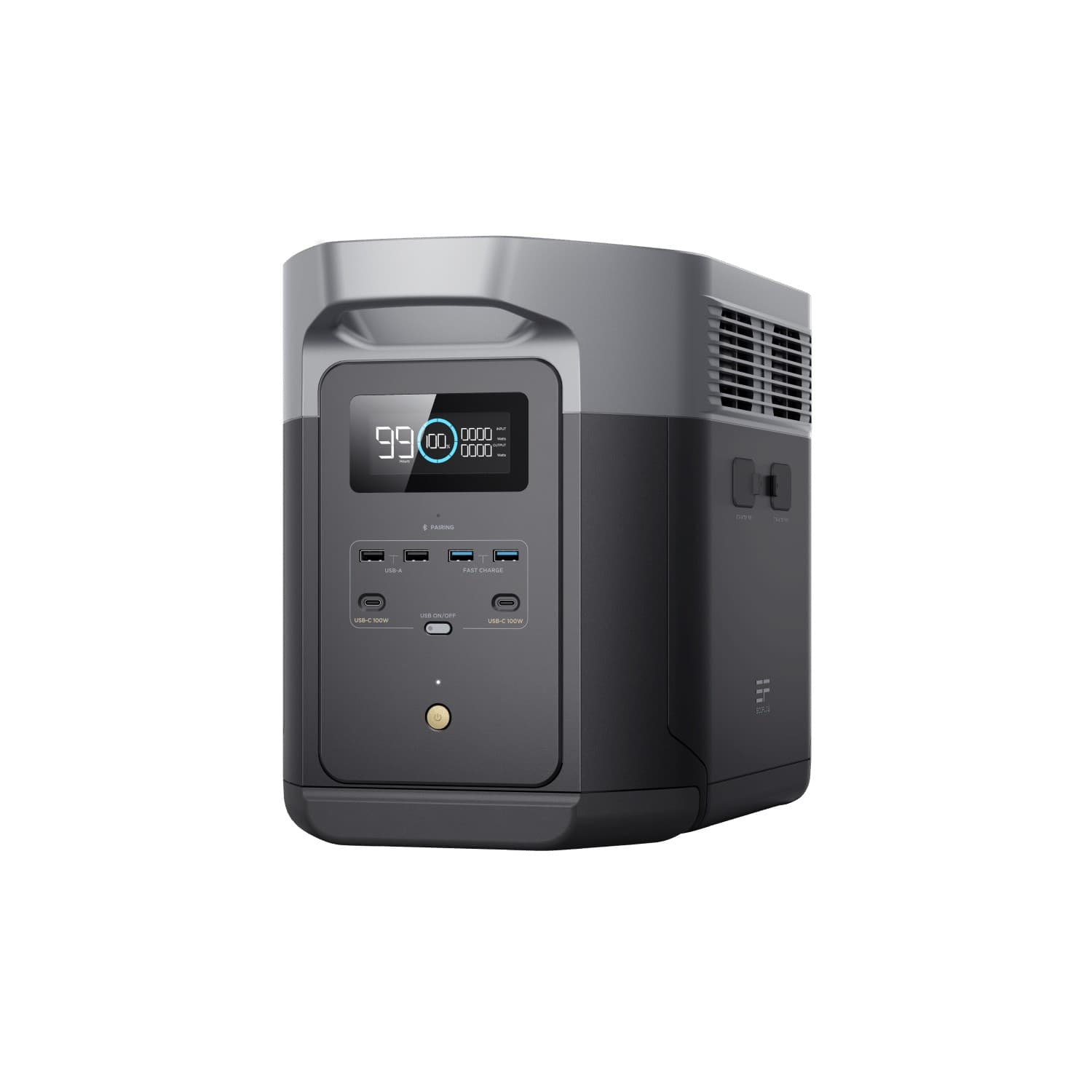
EcoFlow DELTA 2 Max Portable Power Station
Evaluated for household use · Affiliate links disclosed
Built for large families and extended outages
Why we chose it
When the standard Delta 2 isn't enough, the Max doubles capacity to 2,048 Wh and bumps output to 2,400 W — enough to start and run heavy appliances that smaller stations stall on.
Buy From
EcoFlowAffiliate links · We earn a small commission at no cost to you. How this works
We evaluate every pick for real-world reliability.
Why this matters
Why this matters in an emergency
Some outages are a few hours; some are a few days. When you're staring down the longer kind — a hurricane aftermath, an ice storm that downs lines for the week, a rural property where the utility is in no hurry — a small power station starts rationing fast. The Delta 2 Max is built for that longer haul. With 2,048 watt-hours out of the box — roughly a day of household essentials — and room to grow to about 6,000 with added batteries, it's sized to keep a full-size refrigerator, a few lights, your devices, and a low-draw medical device like a CPAP running well into a long outage; add solar or expansion batteries and it stretches into multi-day territory.
It still won't run central heat or AC for long — physics doesn't bend for anyone — but for keeping a household's essentials alive through the kind of long blackout that defeats smaller units, indoors and without fumes, it's a genuinely capable choice for a regular family. If your outages are measured in days, not hours, this is the tier that matches the problem.
How We Evaluated
How we evaluated this
We researched the Delta 2 Max the way we'd vet a serious, multi-day backup before trusting it: we took EcoFlow's published specs — the 2,048-watt-hour capacity, the 2,400-watt output with a 4,800-watt surge, the 1,000-watt solar input, and the expansion to about 6,000 — and checked them against independent bench testing from reviewers who put these units through measured load and recharge cycles. StorageReview, for instance, measured about 1,800 watt-hours of usable energy at a steady 350-watt load, short of the rated 2,048, and tracked the energy it took to recharge.
The Delta 2 Max is a serious purchase, so we're clear about sourcing: we don't have hands-on time with this exact unit yet, and the figures here come from EcoFlow and from the independent testers named in our sources, with any disagreements flagged. When we get one on our own bench, we'll add what we measure.
Our pick: EcoFlow DELTA 2 Max Portable Power Station
The verdict
The EcoFlow Delta 2 Max is a high-capacity, expandable LFP battery station — 2,048 watt-hours out of the box, growing to about 6,000, with a 2,400-watt output and a five-year warranty. It's now the previous generation, with EcoFlow's Delta 3 Max Plus above it as the current 2-kilowatt-hour model, but it remains a proven, lower-output-but-capable option at a friendlier outlay than the newest unit. If your outages run for days and you want serious capacity you can expand and feed with solar, it still earns the pick.
What it does well
The Delta 2 Max's whole reason for existing is capacity, and it delivers. Its 2,048 watt-hours is double the standard Delta 2, and it accepts add-on batteries to climb to about 6,000 — enough to carry a household's essentials across an extended outage, not just an evening. The 2,400-watt continuous output, with a 4,800-watt surge and up to 3,400 watts in X-Boost mode, means it doesn't just trickle power; on paper it can start and run high-demand appliances that smaller units stall on. As with the rest of the line, it's lithium iron phosphate (LFP) — safe indoors, no carbon monoxide, long-lived.
Where it really separates from the pack is solar. It accepts up to 1,000 watts of panels, which is a lot, and that changes the math: with a decent array on a sunny day you can refill it while you use it — what turns a long outage from a countdown into something you can sustain. On sound, EcoFlow lists it around 30 decibels at a light 500-watt load measured about 20 inches away; that's the manufacturer's quiet-end best case, not an independent figure we found, and the fans get louder under heavy draw and fast charging. The wall recharge is quick for a battery this size.
What it does poorly
The honest cost is weight. At about 50 pounds (23 kg), this is not a unit you carry one-handed or sling into a car — it's a two-person lift or a job for a cart, and it lives in one spot. And the usable energy, while large, is finite: in independent bench testing it delivered about 1,800 watt-hours at a steady 350-watt load — short of the 2,048 on the label, as real-world inverter draw always is. Like everything in this class, it won't run central air conditioning or whole-home electric heat for any meaningful time — the draw is simply too high, and leaning on it for that drains even this large battery quickly. The expansion batteries that unlock its full capacity are add-ons.
Where it shines
Long outages and partial off-grid living, especially paired with solar. It can keep refrigeration, lights, communications, and a low-draw medical device like a CPAP running through the kind of extended blackout that defeats smaller units, and the solar input lets it stretch much further in good weather.
Where it frustrates
If you bought it hoping to run heat or air conditioning, you'll be disappointed fast. And if you need to move it often, those ~50 pounds will wear on you — this is gear that wants a home, not a backpack. Match it to long outages and high-capacity needs, and it's hard to out-grow.
A note on which generation this is
One thing to know before you buy: the Delta 2 Max is now the previous generation. EcoFlow's successor in the same 2-kilowatt-hour class is the Delta 3 Max Plus — same 2,048 watt-hours, but a higher 3,000-watt output and a 6,000-watt surge, which EcoFlow markets as '25 percent more power' than the Delta 2 Max. It became available in late 2025. That doesn't make the Delta 2 Max obsolete: it's still sold, still backed by the five-year warranty, and still a strong value for the capacity. Want the newest, higher-output design? Look at the Delta 3 Max Plus. Want a proven previous-gen unit at this capacity? The Delta 2 Max still earns its place.
Other options to consider
EcoFlow Delta 2
The smaller sibling and our overall pick — the right size for most homes. If your outages are hours, not days, the standard Delta 2 covers the same essentials for noticeably less money and weight. Step up to the Max only if you genuinely need the extra capacity or plan to add solar and expansion batteries.
Read full review →Bluetti AC200L
A capable high-capacity alternative from a respected brand. We haven't put it through our own research pass yet, so we won't claim a head-to-head winner — if you're cross-shopping at this size, it's worth a look alongside the EcoFlow.
Read full review →EcoFlow Delta 3 Max Plus (the current generation)
EcoFlow's successor to the Delta 2 Max in the same 2-kilowatt-hour class, and the one to look at if you want the latest. It keeps the 2,048 watt-hours but steps output up to 3,000 watts with a 6,000-watt surge — EcoFlow markets it as '25 percent more power' than the Delta 2 Max — and it became available in late 2025. The Delta 2 Max isn't beaten so much as succeeded: it's still sold and still a strong value, so the choice comes down to whether you want the newer, higher-output design or a proven previous-gen unit at this capacity.
Read full review →
You might also like
Longevity
How long will this actually last
Like the rest of EcoFlow's Delta line, the Max runs on LFP cells rated for roughly 3,000 charge cycles to 80% capacity — that's EcoFlow's own figure, which we haven't independently verified. That would be well over a decade of weekly use before the battery noticeably weakens, and far longer for the typical household that only cycles it during outages. The chemistry ages gently: years in, it still works, it just holds a bit less. There's nothing to maintain — no oil, no fuel, no annual service — and the cooling fans are the only real moving parts.
The one nuance with this unit is its expansion batteries, if you add them: keep the whole stack at a moderate charge in storage and top it off every few months, since a battery left fully drained for a long stretch loses capacity. Store it somewhere climate-controlled, not a baking garage or a freezing shed, because heat and deep cold age cells faster than actual use. Backed by a five-year warranty and an expandable, replaceable design, the Delta 2 Max is a buy-it-once purchase that should be ready for many outages to come.
Questions people actually ask
How long will the Delta 2 Max actually power my house during an outage?
Can I run it indoors safely?
How much solar do I need to keep it charged?
Is it too heavy to be practical?
Is the Max worth it over the standard Delta 2?
Is the Delta 2 Max still current, or has it been replaced?
Technical Specifications
| Surge | 4800W |
| Output | 2400W |
| Weight | ~50 lbs (23 kg) |
| Capacity | 2048Wh |
| Battery Type | LFP (LiFePO4) |
| Recharge Time | 0–80% ~1.1 hr (AC); ~43 min (AC+solar) |
Sources we consulted
- EcoFlow — DELTA 2 Max (official product page)
- StorageReview — EcoFlow DELTA 2 Max Review (independent bench testing)
- EcoFlow — DELTA 3 Max Plus (official product page)
- T3 — EcoFlow DELTA 3 Max Plus launch (2025-11-28)
- StorageReview — DELTA 3 Max Plus & Ultra Plus Review (independent)
- Goal Zero — Yeti 3000X (official product/spec page)
We may earn a commission when you buy through links on this page. How this works
Preparedness Gear
EcoFlow DELTA 2 Max Portable Power Station
Evaluated for household use · Affiliate links disclosed
Built for large families and extended outages
Why we chose it
When the standard Delta 2 isn't enough, the Max doubles capacity to 2,048 Wh and bumps output to 2,400 W — enough to start and run heavy appliances that smaller stations stall on.
Buy From
EcoFlowAffiliate links · We earn a small commission at no cost to you. How this works
We evaluate every pick for real-world reliability.