Who this is for
Households that need more than a 1-kWh unit — bigger loads, longer runtime, or an expandable battery for whole-day/multi-day backup. A sensible step up from the Delta 2 when 1 kWh isn't enough.
Skip if
Skip it if a 1-kWh unit covers your needs — the Classic or Delta 2 are lighter and cheaper for phones, a fridge, and lights. Skip it too if weight matters a lot (about 22 kg / 49 lb) or you want a proven long-term reliability record — it's a 2026 release with no durable owner-failure history yet. And plan around ~80% of the 2048 Wh nameplate as real usable energy.
Preparedness Gear
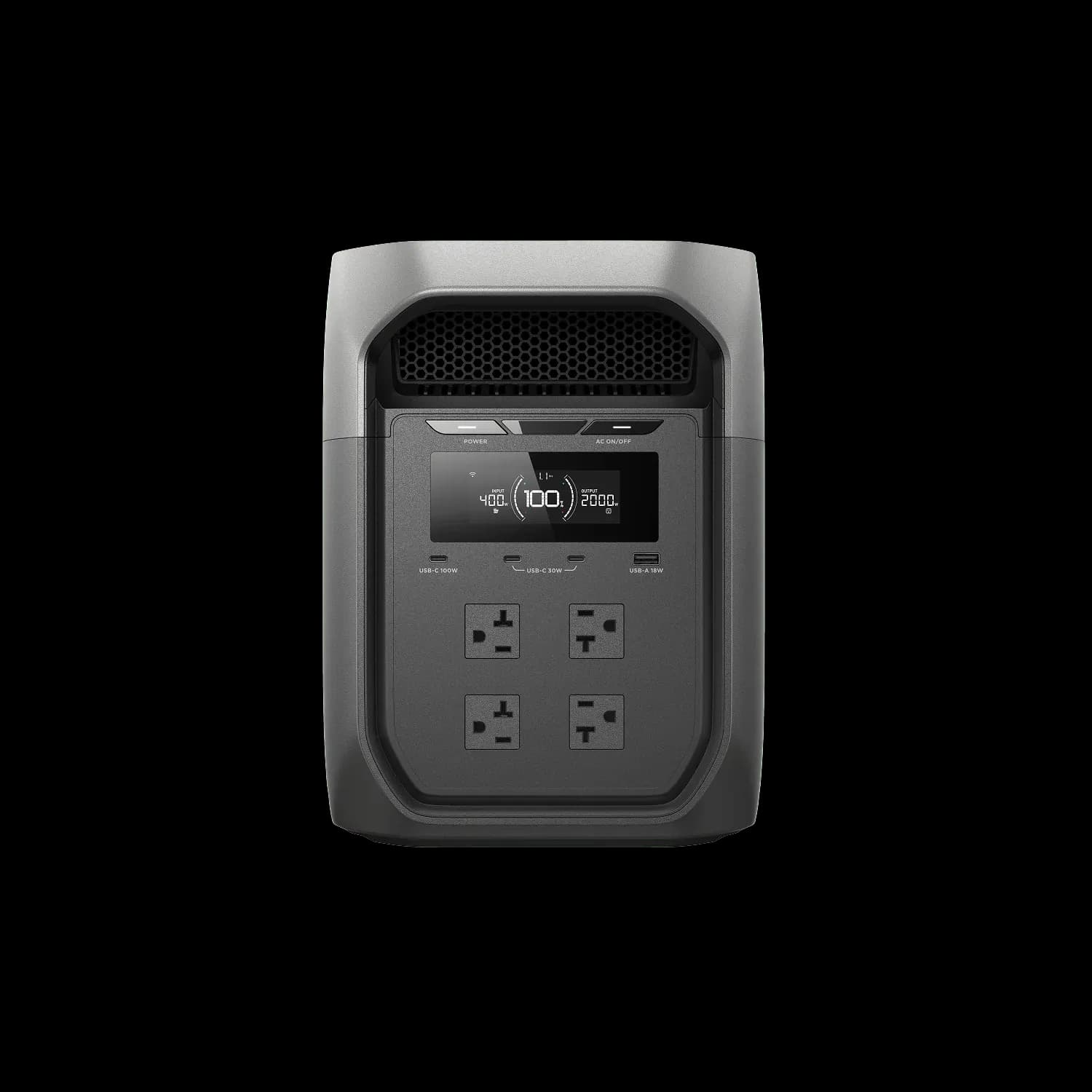
EcoFlow DELTA 3 Max Plus Portable Power Station (2048Wh)
Evaluated for household use · Affiliate links disclosed
A 2-kWh, 3000-W expandable Delta 3 for bigger loads — plan on about 80% of the nameplate as usable energy.
Why we chose it
The high-capacity, expandable Delta 3: 2048 Wh, 3000 W, X-Boost 3.0 to 3800 W, and a 2-10 kWh expandable battery — the step up from our Delta 2 pick for bigger loads and whole-day backup. Independent testing puts real-world usable energy at about 80% of the nameplate.
Buy From
EcoFlowAffiliate links · We earn a small commission at no cost to you. How this works
We evaluate every pick for real-world reliability.
Our pick: EcoFlow DELTA 3 Max Plus Portable Power Station (2048Wh)
The verdict
The DELTA 3 Max Plus is the big-capacity end of EcoFlow's Delta 3 line — about double the Classic: 2048 watt-hours, a 3000-watt inverter (6000-watt surge), and X-Boost 3.0 that stretches to 3800 watts for starting demanding gear. Unlike the Classic, its battery is expandable from 2 up to 10 kilowatt-hours, so it can grow into whole-day or multi-day backup. It sits next to our main pick, the Delta 2, as the step up when you need more power and headroom than a 1-kWh unit. One honest, reader-relevant number from independent testing: you don't get the full 2048 Wh in practice — StorageReview measured about 1.64 kWh usable (~80% of the nameplate) and TrustedReviews measured a round-trip efficiency near 80%, so plan your capacity around ~80% of the rated figure. We researched this one from EcoFlow's specs plus independent hands-on tests (StorageReview, TrustedReviews); we haven't run it ourselves.
Why We Chose This
The high-capacity, expandable Delta 3: 2048 Wh, 3000 W, X-Boost 3.0 to 3800 W, and a 2-10 kWh expandable battery — the step up from our Delta 2 pick for bigger loads and whole-day backup. Independent testing puts real-world usable energy at about 80% of the nameplate.
What owners report
What independent hands-on testing found. The most useful real-world finding is that you don't get the full nameplate: StorageReview measured about 1.64 kWh of usable energy from the 2048 Wh rating (~80%), and TrustedReviews measured a best round-trip efficiency of 79.9% — so plan your capacity around ~80% of 2048 Wh. That's normal underperformance versus the nameplate for this class, not a fault. In testing, inverter efficiency ran about 87% at load and recharge efficiency about 88%, the UPS switchover measured 8 milliseconds, and the unit is drop-rated to 0.25 meters. One minor ergonomic note from TrustedReviews: larger plugs can crowd an adjacent socket. (Findings attributed to StorageReview and TrustedReviews hands-on testing; the noise figure is EcoFlow's load-qualified 25 dB at a 600 W load, which the testers' informal "under 25 dB" reading is consistent with.)
Long-term owner reliability isn't established yet. The Max Plus is a 2026 release, and the independent coverage is review-period hands-on testing, not long-term ownership. There isn't yet a durable record of owner-reported failures over months or years, so we can't tell you how it holds up over the long haul — we'll update this section once that history exists.
Other options to consider
EcoFlow Delta 2
Our main 1-kWh pick — the previous generation, lighter and cheaper, with a long proven owner-reliability record the Max Plus does not have yet.
Read full review →EcoFlow DELTA 3 Classic
The 1-kWh Delta 3 — newer cells and fast charging at a lower price, if you do not need the Max Plus capacity or expandability.
Read full review →EcoFlow DELTA 3 Max (non-Plus)
The same 2048 Wh size at lower output (2400 W) — less surge headroom and no X-Boost 3.0.
Technical Specifications
| Capacity | 2048 Wh (real-world usable ~1.64 kWh, about 80% of nameplate, in independent testing) |
| Rated Output | 3000 W (6000 W surge) |
| X-Boost Ceiling | 3800 W (X-Boost 3.0) |
| Expandable Capacity | 2-10 kWh |
| Battery | Automotive-grade full-tab LFP |
| Charge 0-80% (Via Smart Generator) | 43 min (EcoFlow) |
| Charge 0-80% (Wall AC, 1800 W) | 64 min (StorageReview, measured) |
| Charge 0-80% (AC, 2300 W Input) | 47 min (TrustedReviews, measured) |
| UPS Switchover | Under 10 ms (EcoFlow); 8 ms measured (StorageReview) |
| Cycle Life | EcoFlow rates the Delta 3 series at 4,000 cycles to 80% (not independently verified) |
| Noise | 25 dB at a 600 W load (EcoFlow’s figure) |
| Weight | ~22.1 kg (49 lb) |
| Ports | 4x AC (NEMA 5-20R) - 2x USB-C 45W - 1x USB-C 140W - 1x USB-A 15W - 12V car - 12V Anderson |
Sources we consulted
We may earn a commission when you buy through links on this page. How this works
Preparedness Gear
EcoFlow DELTA 3 Max Plus Portable Power Station (2048Wh)
Evaluated for household use · Affiliate links disclosed
A 2-kWh, 3000-W expandable Delta 3 for bigger loads — plan on about 80% of the nameplate as usable energy.
Why we chose it
The high-capacity, expandable Delta 3: 2048 Wh, 3000 W, X-Boost 3.0 to 3800 W, and a 2-10 kWh expandable battery — the step up from our Delta 2 pick for bigger loads and whole-day backup. Independent testing puts real-world usable energy at about 80% of the nameplate.
Buy From
EcoFlowAffiliate links · We earn a small commission at no cost to you. How this works
We evaluate every pick for real-world reliability.